
Alpha Common Faults and Error Codes: Meanings and Safe Checks
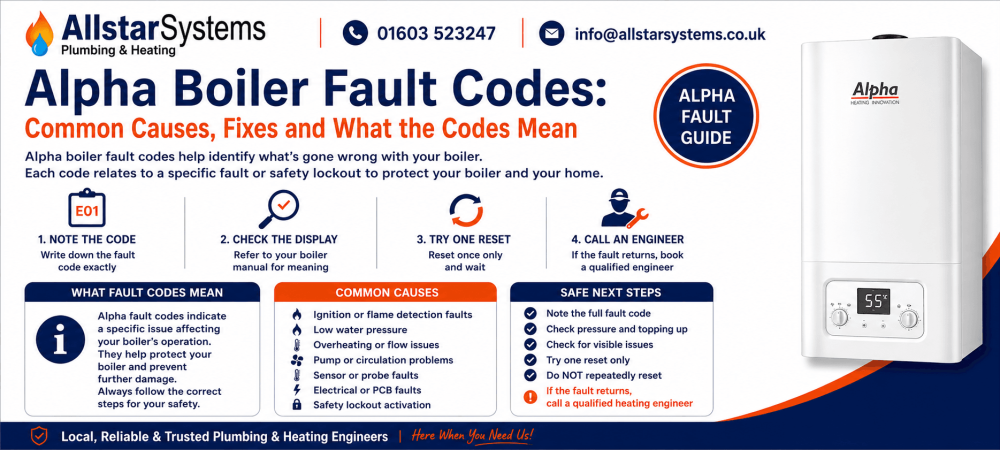
Alpha boilers show error codes to help identify why heating or hot water has stopped. These screen messages can point towards pressure loss, ignition failure, overheating, flame signal loss, sensor trouble, fan problems, pump faults, or control issues.
However, meanings can change between ranges. So, always check the manual for your exact model. This guide covers common E-Tec Plus and Evoke messages, but it should not replace manufacturer guidance.
If a warning returns after one reset, arrange professional boiler repair. Do not remove the casing, touch internal parts, or try to repair gas, flue, wiring, burner, fan, pump, or PCB components.
What do these fault codes mean?
A fault code gives a clue about the area that needs attention. For example, one message may relate to ignition. Another may point towards pressure, temperature, airflow, communication, or circulation.
Even so, the display does not always confirm the exact cause. It gives an engineer a useful starting point.
You can check power, controls, water pressure, and other gas appliances. However, internal diagnosis needs a qualified engineer.
Common error codes and meanings
E01 – Ignition failure
On E-Tec Plus models, E01 means the burner has failed to light.
Possible causes include poor gas supply, ignition part failure, flame sensing trouble, gas valve defects, or PCB problems.
You can check whether other gas appliances work. If they do not, contact your supplier or a qualified professional. Do not inspect ignition parts yourself.
E02 – Overheat lockout
On E-Tec Plus models, E02 means the appliance has shut down because it became too hot.
Poor water movement, trapped air, a pump problem, or closed valves can cause overheating. If the warning returns after one reset, book heating system checks.
E03 – High flue temperature
On E-Tec Plus models, E03 means the appliance has detected unusually high flue temperatures.
This may involve flue performance, restricted water movement, trapped air, or sensor trouble. Since the flue forms part of the safety setup, an engineer should inspect it.
E05 – Central heating flow sensor problem
On E-Tec Plus models, E05 points to the central heating flow sensor.
This part reads the temperature of water leaving the appliance. If it fails, the unit may struggle to control radiator heat.
The sensor, wiring, or connections may need testing.
E06 – Hot water sensor problem
On E-Tec Plus models, E06 relates to the domestic hot water sensor.
This part helps manage tap water temperature. Sensor damage, wiring defects, or poor connections can trigger the message.
In some cases, flow, pressure, or heat exchanger problems may also play a part.
On E-Tec Plus models, E10 means the water pressure is too low.
This often happens after bleeding radiators. However, leaks, expansion vessel faults, pressure relief valve issues, or switch problems may also cause pressure loss.
Check the pressure gauge. If the reading drops again after topping up, book a repair.
E16 – Fan problem
On E-Tec Plus models, E16 points to the fan or its wiring.
The fan helps move combustion gases through the flue. Because it supports safe operation, an engineer must test this part.
E20 – Flame sensing problem
On E-Tec Plus models, E20 means the appliance cannot read the flame correctly.
The cause may sit with the sensing electrode, lead, wiring, gas valve, or burner area. This relates to combustion, so it needs expert testing.
E22 – PCB software problem
On E-Tec Plus models, E22 relates to PCB software.
The PCB controls key functions inside the appliance. A PCB message does not always mean the board needs replacing. First, an engineer should test the appliance and linked parts.
E23 – Return sensor problem
On E-Tec Plus models, E23 points to the return temperature sensor.
This sensor reads water coming back from the heating circuit. Wiring, connections, sensor failure, or poor circulation may trigger the message.
E27 – Primary circuit overheat
On E-Tec Plus and Evoke models, E27 relates to overheating in the primary circuit.
Air inside the heat exchanger is a common cause. However, pump faults, closed valves, sludge, or poor circulation may also contribute.
If radiators heat poorly, the wider heating system may need attention.
E29 – Flue sensor problem
On E-Tec Plus and Evoke models, E29 points to the flue sensors.
These parts help monitor safe operation. Therefore, a qualified engineer should inspect the appliance.
E31 – Control communication problem
On E-Tec Plus and Evoke models, E31 means the appliance has trouble communicating with the Climatic control.
Battery failure, weak RF signal, receiver issues, or wiring problems may cause this. You can check batteries and settings. However, wiring checks need an engineer.
E37 – Low supply voltage
On E-Tec Plus and Evoke models, E37 means the voltage supply is too low.
Check that your property has power. Also, make sure the appliance switch is on. Do not inspect wiring yourself.
E38 – Flame signal lost
On E-Tec Plus and Evoke models, E38 means a flame was detected and then lost.
Possible causes include gas supply trouble, flame sensing problems, flue issues, or combustion setup faults. Do not keep resetting the appliance. Book safe diagnosis instead.
E43 – Repeated flame signal loss
On E-Tec Plus and Evoke models, E43 means the flame signal has been lost more than once.
High wind around the flue may sometimes contribute. However, gas supply, combustion, electrode, and flue issues may also cause repeat lockouts.
This screen message needs professional diagnosis.
E47 – Reduced burner output
On E-Tec Plus and Evoke models, E47 can relate to high flue gas temperatures.
The appliance may reduce burner output to protect itself. If this continues, it may lock out.
An engineer should check circulation, sensors, flue performance, and combustion setup.
E51 – Climatic RF communication problem
On Evoke models, E51 relates to communication between the Climatic transmitter and the appliance.
Weak batteries often cause this message. If new batteries do not solve it, the RF signal, receiver, or control setup may need testing.
On Evoke models, E60 usually means the pump has stuck or failed.
This may stop radiators reaching the right temperature. It can also lead to overheating.
An engineer should inspect the pump, wiring, and water movement.
What causes common Alpha boiler problems?
Most problems relate to pressure, ignition, overheating, flame sensing, circulation, sensors, fans, pumps, or electronics.
For example, E10 often links to low pressure. E01 points towards ignition. E38 and E43 relate to flame signal loss. E27 and E60 often involve poor water movement.
However, the exact cause depends on the model, pressure, controls, gas supply, wiring, and heating circuit condition.
Safe checks you can do
You can make a few simple checks before calling an engineer.
First, check the pressure gauge. Your manual should show the correct range.
Next, check the thermostat and timer. Make sure they call for heating or hot water.
Then check power. Confirm that your property has electricity and the appliance switch is on.
If the message relates to ignition or flame signal, check other gas appliances. If they do not work, contact your supplier or a qualified professional.
You can try one reset only. If the same message returns, stop resetting.
Never remove the casing. Also, do not touch internal parts, wiring, gas valves, fans, flue parts, burners, pumps, or PCB components.
How to reduce future problems
Regular servicing can help reduce the risk of unexpected breakdowns.
During a service, an engineer can check safety parts, test performance, inspect key components, and spot early wear.
You can also watch the pressure gauge. Sudden drops may point to a leak or expansion issue.
Cold radiators, slow heat-up times, odd noises, and repeated lockouts also deserve attention.
Good water movement matters too. Sludge, trapped air, poor pump performance, or closed valves can all affect reliability.
Codes that need model confirmation
Some display messages need model confirmation. Do not apply a meaning without checking the correct manual.
These messages vary by range. Take a photo of the display and check the manual for your exact appliance.
On Evoke models, E60 usually points to the pump. Other ranges may use this message differently.
On the E-Tec Plus table reviewed, hot water sensor trouble appears as E06. So, confirm E50 in the correct manual.
On the E-Tec and E-Tec Plus tables reviewed, low pressure appears as E10. So, do not assume E34 means the same thing.
This message was not listed in the E-Tec table reviewed. If you see it, check whether the display could be E27, E29, or E38.
E90 was not listed in the E-Tec or Evoke tables reviewed. Take a photo, confirm the model, and check the exact manual.
What should you do next?
A screen message helps narrow down the likely problem. However, it does not always give the full diagnosis.
Start with simple checks. Look at pressure, power, controls, and other gas appliances.
Then try one reset if your manual allows it. If the message returns, arrange professional help.
Ignition, flame sensing, overheating, fans, flues, pumps, electronics, and wiring all need safe testing. A qualified engineer can confirm the cause and complete the right repair.
Alpha Fault Codes FAQs
What does Alpha E10 mean?
On Alpha E-Tec Plus models, E10 usually means low primary system pressure. If the pressure keeps dropping, there may be a leak, expansion vessel issue or pressure relief valve fault.
What does Alpha E01 mean?
On Alpha E-Tec Plus models, E01 means ignition failure. The boiler has not detected a flame during startup.
What does Alpha E02 mean?
On Alpha E-Tec Plus models, E02 means overheat lockout. This often relates to poor circulation, trapped air, pump problems or restricted flow.
What does Alpha E38 mean?
On Alpha E-Tec Plus and Alpha Evoke models, E38 means the boiler detected a flame, then lost the flame signal during operation.
What does Alpha E60 mean?
On Alpha Evoke models, E60 usually means a pump fault. The pump may be stuck or have an electrical issue.
Can I reset an Alpha boiler fault code?
You may reset the boiler once if the manual allows it. If the fault returns, stop resetting and call an engineer.
Are Alpha boiler fault codes the same on every model?
No. Alpha fault codes can vary by boiler range and model. Always check the exact boiler manual.
Does an Alpha fault code always need an engineer?
Not always. You can check pressure, power and controls first. However, gas, flame, fan, flue, PCB, pump, sensor and wiring faults need professional help.