



Alpha E20 Fault Code: Flame Sensing Causes, Safe Checks and Repair Advice
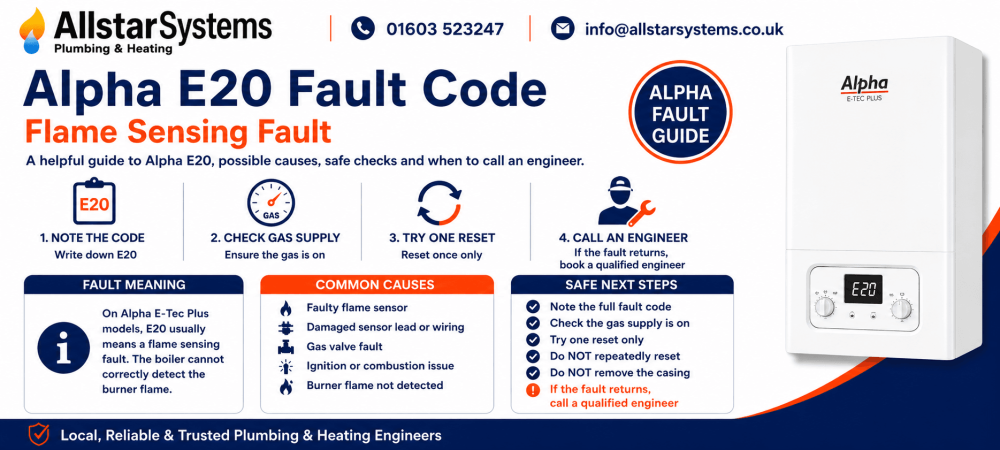
An Alpha E20 fault code usually points to a flame sensing problem. On Alpha models that use this code family, the boiler has not detected the flame signal correctly.
This does not normally mean low pressure. Instead, E20 should be treated as an issue linked to burner flame detection, ignition proving, wiring, or the control circuit.
When the boiler cannot confirm a safe flame, it will often shut down. This protects the appliance and your home.
What Does Alpha E20 Mean?
Alpha E20 usually means the boiler has tried to run, but the flame signal has not been confirmed as expected.
In some cases, the burner may light briefly. However, the control board still needs a clear flame detection signal before normal operation can continue.
If that signal is weak, missing, or unstable, the boiler could lock out. As a result, your heating and hot water may stop until the fault has been checked.
This code should not be confused with a pressure, circulation, or hot water sensor warning.
Why the E20 Code Appears
Several issues can trigger this warning. Most relate to flame detection, burner operation, wiring, or control readings.
Faulty sensing electrode
The flame sensing electrode helps the boiler confirm that the burner has lit. If it becomes worn, dirty, damaged, or poorly positioned, the signal may fail.
Damaged sensing lead
A damaged cable or weak connection can stop the signal from reaching the control board. Consequently, the boiler may think no flame is present.
Poor electrical contact
Damp, dirt, corrosion, or heat damage can affect the connection. Even a short break in the circuit can bring up E20.
Burner ignition issue
The burner may fail to light correctly, or it may light and then go out. This can happen when ignition parts, gas supply, or combustion settings need checking.
Control board issue
In rarer cases, the PCB may not read the flame signal correctly. Even so, an engineer should test the common causes before replacing costly parts.
Model-specific fault logic
Different Alpha ranges can use codes in different ways. Therefore, the exact model should always guide diagnosis.
Signs You Might Notice
Your boiler may lock out soon after trying to start. It may also fire briefly before shutting down again.
You may lose heating, hot water, or both. In addition, E20 may return soon after a reset.
These signs do not prove which part has failed. They only show that the boiler cannot confirm safe burner operation.
Safe Checks Before Booking a Repair
You can make a few simple checks without opening the case.
First, note your exact Alpha model. This helps match the warning to the correct manual.
Next, check that the boiler has power. Make sure the fused spur, timer, programmer, thermostat, and room controls are set correctly.
Then, check whether other gas appliances work. If your hob or fire has also stopped, the issue may relate to the property supply.
After that, try one reset using your Alpha manual. If the warning clears and stays away, monitor the boiler closely.
However, if E20 returns, stop resetting it. Repeated resets will not repair a failed electrode, damaged lead, burner issue, or PCB fault.
Important safety note: never remove the boiler cover. Do not test gas parts, burners, electrodes, wiring, PCB parts, or combustion components yourself.
Can You Fix Alpha E20 Yourself?
You can identify the model, check power, check external controls, and try one approved reset.
Beyond that, call a Gas Safe registered engineer. Flame sensing and burner checks need safe access, correct tools, and proper combustion testing.
Therefore, DIY repair is not suitable when the warning comes back.
How an Engineer May Repair It
A heating engineer will test the flame proving sequence step by step. They may check the sensing electrode, spark electrode, ignition lead, burner condition, wiring, gas supply, and PCB response.
They may also inspect combustion readings, flame stability, earth continuity, and related connections. Once they find the cause, they can clean, repair, or replace the failed part.
Afterwards, they should reset the boiler and confirm safe operation.
Does E20 Mean You Need a New Boiler?
Usually, no. Many flame sensing and wiring faults can be repaired.
However, age, reliability, part availability, and repair cost all matter. If your boiler breaks down often, replacement may offer better long-term value.
Even so, arrange a diagnosis before deciding.
How to Reduce Future E20 Problems
Annual servicing helps reduce the risk of flame sensing faults. During a service, an engineer can inspect key parts, test safe operation, and check combustion performance.
Also, act quickly if the boiler locks out more than once. Early diagnosis can prevent a small ignition issue from becoming a larger repair.
When to Call a Gas Safe Engineer
Call an engineer if E20 returns after one reset. You should also book help if the boiler fires briefly and then shuts down.
In addition, arrange a visit if the appliance remains locked out, makes unusual ignition noises, or stops heating your home.
A professional can test the burner and flame sensing circuit safely.
Final Advice on Alpha E20
Alpha E20 usually relates to flame sensing on the boiler models that use this code family. It is not normally a pressure fault.
Check your exact model, confirm power and controls, then try one reset if your manual allows it. If the warning returns, book a repair rather than resetting the boiler repeatedly.
Regular servicing can also help reduce repeat faults and keep your heating system working safely.
Alpha E20 fault code FAQs
What does the Alpha E20 fault code mean?
On the Alpha code families that use this meaning, it points to a flame sensing fault. In simple terms, the boiler is not detecting the flame signal correctly.
Is Alpha E20 a pressure fault?
It should not be treated that way by default. The safer model-aware explanation is a flame sensing fault on the Alpha code families that use code 20 in this way.
Can I reset an Alpha boiler with E20 showing?
Usually, you can try one reset if your manual allows it. However, if the code returns, the next step is proper diagnosis rather than repeated resets.
Do I need an engineer for Alpha E20?
If the fault keeps coming back or the boiler stays in lockout, yes. Most recurring E20 faults need proper flame sensing or control-path diagnosis before the right repair can be made.
Where should I check the exact meaning of Alpha E20?
Start with the appliance manual and the exact model reference on the boiler. That is the safest way to confirm how your Alpha range uses the code.