



Ariston Error Codes: Clear Meanings, Safe Checks and Repair Advice
When your heating display shows an error number, it gives you a clue about the problem. The warning may relate to pressure, ignition, overheating, circulation, electronics, sensors, or airflow.
Some issues need only a simple user check. However, faults linked to combustion, wiring, fans, sensors, or internal controls need a Gas Safe registered engineer.
This guide explains common Ariston warnings, what they mean, and what you can safely do first.
What do these warning numbers mean?
The number on the screen points towards the area that needs attention. It does not always give a full diagnosis.
For example, one warning may show low system pressure. Another may suggest poor ignition, weak circulation, overheating, or an electronic issue.
Because meanings can vary by model, always check the manual for your exact unit. Also, avoid repeated resets if the same warning keeps returning.
Common Ariston warning numbers
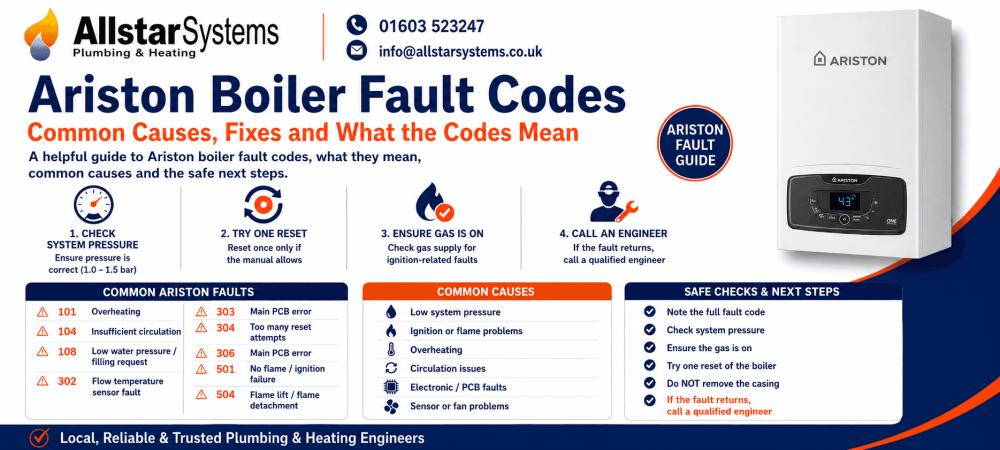
Below are several numbers often seen on these heating appliances. Use this section as a simple guide, not as a final diagnosis.
The 101 warning usually means the unit has overheated. This may happen when heated water cannot move through the system properly.
Common causes include poor circulation, a weak pump, a blockage, or a sensor issue. Therefore, do not keep pressing reset if this warning comes back.
The 104 warning often points to poor circulation. In simple terms, water may not move around the radiators and pipework as it should.
Trapped air, sludge, closed valves, a tired pump, or blocked pipework may cause this issue. If it returns, arrange a professional inspection.
The 108 warning often relates to low system pressure. When the reading drops too far, the unit may stop heating.
Check the gauge first. Many sealed systems sit near 1 to 1.5 bar when cold. Also, look for visible leaks before topping up.
The 302 warning may show an internal communication issue. The display, control board, wiring, or another electronic part may not send signals correctly.
Try one reset if your manual allows it. However, if 302 appears again, book qualified testing.
The 303 warning can also suggest a control or communication problem. The unit may lock out, fail to respond, or stop during use.
A reset may clear a short signal glitch. However, a returning warning often needs checks on wiring, the PCB, and internal connections.
The 304 warning usually appears after too many resets within a short time. Often, this means another problem has not been fixed.
Stop pressing reset. Follow your manual, then arrange help if the display does not clear.
The 306 warning often points to an internal electronic problem. The PCB, display, wiring, or control circuit may need testing.
Do not remove the cover. Instead, book a qualified repair if the warning returns.
The 501 warning usually means ignition has failed. The unit has tried to light but has not confirmed a safe burn.
Possible causes include a closed supply valve, poor fuel supply, worn ignition parts, or a sensor problem. If other gas appliances fail too, contact your supplier.
The 504 warning often relates to flame lift or an unstable burn. This means the burner has not maintained a safe, steady flame.
Treat this seriously. Because it may involve combustion safety, arrange a professional inspection.
Why these warnings appear
Display warnings can appear for many reasons. Low pressure, poor ignition, overheating, weak circulation, sensor issues, airflow restrictions, and electronic failures can all cause a shutdown.
Sometimes the cause sits outside the appliance. For example, a leak, power cut, closed valve, or supply issue may affect operation.
However, anything inside the case needs qualified diagnosis.
Safe checks you can make first
You can complete a few basic checks before calling an engineer.
First, look at the pressure gauge. If it sits below the range in your manual, the system may need topping up. However, check for visible leaks first.
Next, try one reset only if your manual recommends it. If the same warning returns, stop resetting the unit.
Then, check whether your gas supply works. If a hob or fire also fails, the issue may sit with the supply.
Also, look for simple external causes. These include a power cut, visible leak, closed radiator valve, or blocked outside flue terminal.
Do not remove the casing. Internal parts, wiring, combustion areas, fans, and sensors must stay with qualified professionals.
Can you fix the issue yourself?
You could solve some simple problems yourself. For example, you may top up low pressure or reset the unit once.
However, avoid work on ignition parts, flue components, sensors, fans, wiring, or the PCB. These areas need the right tools and legal qualifications.
If the warning returns, book a repair. Repeated resets could hide the real cause.
How an engineer may help
A qualified engineer will test the system safely. They may inspect the fuel supply, ignition parts, pressure readings, circulation, wiring, sensors, fan, and PCB.
After that, they can advise whether cleaning, adjustment, repairs, or replacement parts make sense.
Do you need a replacement?
Not always. Many display warnings relate to parts that can be repaired or replaced.
However, if the unit is old, inefficient, or unreliable, replacement could offer better value. A professional can compare age, repair cost, safety, and performance.
How to reduce future problems
Annual servicing helps reduce breakdown risk. During a service, an engineer can test safety controls, inspect key parts, and spot early wear.
You can also help by acting early. Watch the gauge, fix leaks quickly, and avoid repeated resets.
When to call a Gas Safe engineer
Call a Gas Safe registered engineer if the same warning keeps returning. Also, arrange help if the unit locks out, overheats, fails to ignite, or loses heating often.
You should also call for help with flame, fan, sensor, or electronic warnings.
If you smell gas, turn off the supply if safe. Then open windows, avoid switches and flames, and call 0800 111 999.
Final advice
Error numbers give a useful starting point. However, they do not replace a proper diagnosis.
Check the gauge, try one reset if your manual allows it, and look for simple external issues. After that, if the warning returns, arrange a safe inspection.
Ariston Boiler Fault Codes FAQs
What is the most common Ariston boiler fault code?
One of the most common Ariston fault codes is 108, which usually means low water pressure or a filling request.
What does Ariston 101 mean?
Ariston 101 usually means overheating. This often points to circulation issues, a blockage, or a pump-related fault.
What does Ariston 108 mean?
Ariston 108 usually means the boiler pressure is too low and the system needs topping up.
What does Ariston 501 mean?
Ariston 501 usually means no flame or ignition failure. The boiler has tried to ignite but has not detected a stable flame. You can read more in our Ariston 501 fault code] guide.
What does Ariston 504 mean?
Ariston 504 usually means flame lift or flame detachment, which points to an unstable combustion condition.
Can I reset an Ariston boiler fault code?
Yes, in some cases you can try a reset once. However, if the same code returns, the underlying problem is still present and should be checked properly.
Can low pressure cause an Ariston boiler to stop working?
Yes. Low pressure can trigger a fault code such as 108 and stop the boiler from operating until the pressure is restored.