


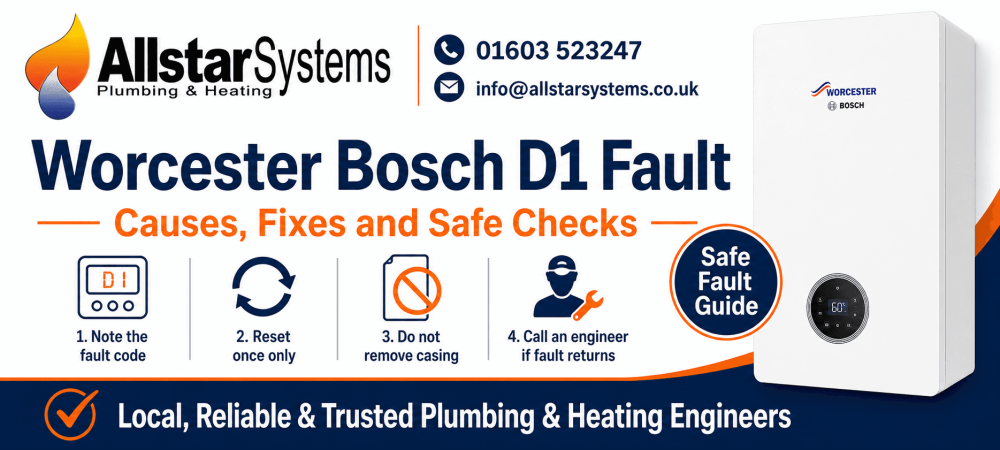
Worcester Bosch D1 Error: Why It Shows and What To Check
A Worcester Bosch D1 error can appear when the appliance receives an unusual return-water temperature reading. This reading comes from a sensor on the water returning from your radiators.
When the signal seems wrong, the unit may pause normal heating. Although this can seem sudden, it helps prevent the appliance from running on poor temperature data.
D1 often links to the return sensor. However, damaged wiring, poor flow, sludge, low pressure, or setup problems may also contribute.
What does the D1 display mean?
The D1 display tells you the appliance has found an issue with the return-water temperature signal.
In simple terms, the control board expects a clear and believable reading. If the reading looks missing, unstable, or outside range, the unit may lock out.
Therefore, you should not assume one part has failed. Instead, the whole signal path needs checking.
Why does the return reading matter?
Your heating appliance uses return-water temperature to control heat output.
For example, cooler returning water can suggest that your radiators still need more heat. Warmer returning water can suggest that the system has nearly met demand.
So, when this reading becomes unreliable, the appliance cannot make safe control decisions. As a result, it may stop and show D1.
Likely reasons for the D1 display
Faulty return sensor
The sensor can fail, drift, or send erratic information. If so, the appliance cannot read the returning water temperature correctly.
Poor cable connection
A loose plug, damaged cable, or weak connection can interrupt the signal. Consequently, the display may show D1 even when the sensor has not failed.
Dirty system water
Sludge and debris can affect flow through pipework and radiators. Also, poor movement can cause uneven temperatures across the heating circuit.
Fitting or setup issue
Some problems relate to how the system was installed, balanced, or configured. Therefore, an engineer may need to inspect the wider heating setup.
Control board problem
If the sensor and wiring pass testing, the board may need checking. This requires professional diagnosis.
Could pressure be involved?
D1 does not simply mean low pressure. Even so, pressure can affect system behaviour.
So, check the gauge when the system is cold, if your model has one. Many sealed systems work near 1 to 1.5 bar.
If the reading is low, follow your manual for topping up. However, avoid repeated filling.
A system that often loses pressure may have a leak or expansion vessel issue. In that case, arrange a repair rather than adding water again.
Checks you can do safely
First, note the exact display code. Also, write down when it appeared and whether heating or hot water still works.
Next, check the pressure gauge while the appliance is cold. Then, compare it with your manual.
After that, look for heating clues. Noisy radiators, cold patches, or slow warm-up can suggest poor water movement.
You may try one reset if your manual allows it. Follow the model instructions exactly.
If D1 returns, stop resetting the appliance. Repeated resets do not solve sensor, wiring, or flow problems.
Do not remove the casing. Internal parts include electrical connections, sealed areas, and gas-related safety components. Therefore, a Gas Safe registered engineer should carry out internal checks.
What should you avoid?
Do not replace the sensor yourself. Also, do not test wiring or control parts without the correct qualifications.
Do not keep topping up the pressure. Frequent filling can hide a leak and add fresh oxygen into the system.
Additionally, do not ignore repeated lockouts. They usually mean the appliance needs proper diagnosis.
When should you call an engineer?
Call an engineer if D1 returns after one reset. Also, book help if the pressure looks right but the warning remains.
You should arrange support if radiators heat unevenly, make noise, or take too long to warm. Likewise, get advice if hot water or heating keeps cutting out.
An engineer can test the return sensor, cable, board, circulation, and water condition. Since those checks involve internal components, they are not suitable for DIY work.
Does D1 mean replacement is needed?
Not usually. D1 often relates to a sensor signal or system condition, rather than a failed appliance.
In many cases, the cause can be found and repaired. However, replacement may be worth discussing if the appliance is old, unreliable, or costly to maintain.
Need help with a Worcester Bosch D1 error?
A Worcester Bosch D1 error usually relates to the return-water temperature signal. Possible causes include the sensor, wiring, poor flow, sludge, pressure problems, setup issues, or the control board.
Start with simple external checks only. Then, if the display remains or returns, arrange a visit from a Gas Safe registered engineer.
Need dependable heating diagnostics, servicing, or repairs? Contact us today for expert support.
Worcester Bosch D1 Fault Code FAQs
What does the Worcester Bosch D1 fault code mean?
The Worcester Bosch D1 fault code usually relates to a sensor or return temperature issue. In many cases, the boiler has detected an unexpected reading and may stop working to protect itself.
What causes a Worcester Bosch D1 fault?
Common causes can include a faulty sensor, loose wiring, poor circulation, low pressure, air in the heating system, or a blocked component. However, a Gas Safe registered engineer should confirm the cause.
Can I fix a Worcester Bosch D1 fault myself?
You can check simple external issues, such as boiler pressure and whether the heating controls are set correctly. However, you should not remove the boiler casing or touch internal boiler parts.
Can I reset my Worcester Bosch boiler with a D1 fault?
You may try one reset if your Worcester Bosch boiler manual recommends it. However, if the D1 fault code returns, stop resetting the boiler and arrange a professional inspection.
Why does my Worcester Bosch boiler keep showing D1?
A recurring Worcester Bosch D1 fault usually means the boiler has an ongoing sensor, wiring, circulation, or temperature control problem. Therefore, the boiler needs proper diagnosis.
Can low boiler pressure cause a Worcester Bosch D1 fault?
Low pressure may contribute to poor circulation and unusual temperature readings. However, repeated pressure loss can also suggest a leak or another heating system issue.
Can dirty heating water cause a D1 fault code?
Yes, sludge or debris can restrict water flow and affect temperature readings. In some cases, a heating engineer may recommend system cleaning or power flushing where appropriate.
Is a Worcester Bosch D1 fault dangerous?
The boiler may lock out to protect itself. However, you should treat any repeated fault code seriously. If you smell gas, suspect fumes, or feel unsafe, leave the property and call 0800 111 999.
Do I need a Gas Safe engineer for a Worcester Bosch D1 fault?
Yes. A Gas Safe registered engineer should inspect Worcester Bosch D1 faults because the issue may involve internal boiler components, sensors, wiring, or combustion-related checks.
Can Allstar Systems repair Worcester Bosch D1 faults?
Yes. Allstar Systems can investigate Worcester Bosch D1 fault codes across Norwich and Norfolk. Our Gas Safe registered engineers can diagnose the fault and recommend the safest repair.