


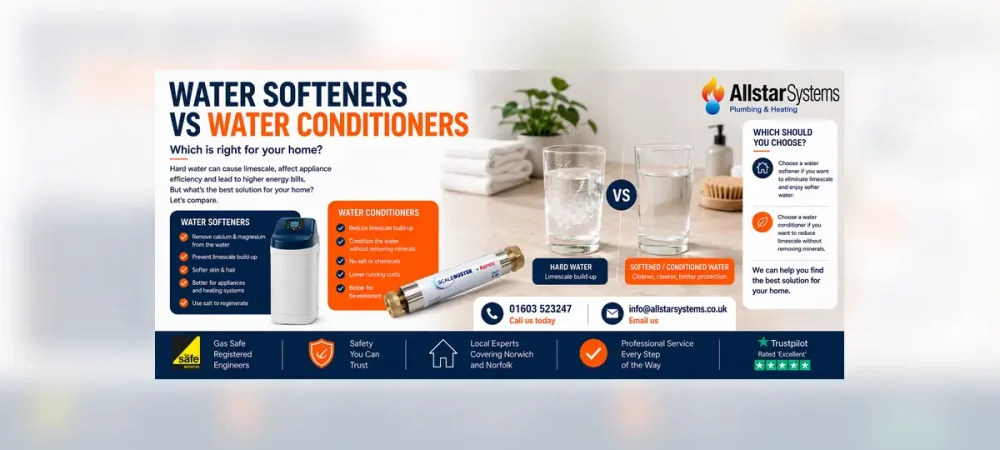
Water Softeners vs Water Conditioners
Hard supply can leave limescale on taps, shower screens, kettles and household appliances. In Norwich and much of Norfolk, this can become a common issue for many homes.
Two common options are water softeners and water conditioners. They sound similar, but they work in different ways. Therefore, the right choice depends on what you want to improve.
A softener changes the supply by removing the minerals that cause hardness. A conditioner does not remove those minerals. Instead, it aims to reduce how much scale sticks to surfaces and appliances.
This guide explains the difference in simple terms.
What Is Hard Water?
Hard water contains higher levels of minerals, mainly calcium and magnesium. These minerals are safe to drink. However, they can leave chalky marks when the supply dries or gets heated.
Common signs include:
- white marks around taps
- scale inside kettles
- cloudy shower screens
- reduced lather from soap
- stiff laundry
- marks on sinks and tiles
- scale around shower heads
- hot water appliances needing regular cleaning
Hard supply is not usually a health concern. However, it can make daily cleaning harder and may affect appliances over time.
What Does a Water Softener Do?
A water softener removes the minerals that cause hardness. Most domestic models use a process called ion exchange.
During this process, the incoming supply passes through resin beads. These beads attract calcium and magnesium. The minerals are then exchanged for sodium ions.
As a result, the home receives softened supply. This can help reduce limescale and improve how soap and shampoo perform.
A softener may help with:
- less scale on taps and screens
- cleaner kettles and appliances
- better soap lather
- softer laundry
- less time spent cleaning
- reduced scale in hot water appliances
However, this type of unit needs maintenance. Salt must be topped up, and the setup must regenerate to keep working well.
In many homes, one cold tap should remain untreated for drinking and cooking. Also, softened supply should not be used to make baby formula.
What Does a Water Conditioner Do?
A water conditioner does not remove hardness minerals. Instead, it changes how those minerals behave.
Some products aim to make scale less likely to stick inside pipework, taps and appliances. Many options are salt-free, which means they need less regular upkeep than a softener.
A conditioner may suit homes where the main aim is scale control, not true softened supply.
It may help with:
- lower maintenance
- no salt top-ups
- less scale build-up
- smaller installation space
- scale management for fixtures and appliances
However, results can vary by product, property and local supply. A conditioner will not give the same feel or effect as a true softener.
The Main Difference
The key difference is simple.
A water softener removes calcium and magnesium from the incoming supply.
A water conditioner keeps those minerals in place but aims to reduce the scale they form.
Therefore, choose a softener if you want a direct treatment for hard supply. Choose a conditioner if you want a lower-maintenance way to manage scale.
Benefits of a Water Softener
A softener can be a strong choice in areas with very hard supply. It gives a more direct result because it removes the minerals that cause the problem.
Possible benefits include:
- true softened supply
- less scale in kettles and appliances
- better soap and shampoo lather
- cleaner shower screens
- less time spent descaling
- softer laundry
- support for hot water appliances
This option may suit homes where limescale builds quickly, cleaning feels constant, or appliances need regular descaling.
However, it is not right for every property. You need space for the unit, drainage, salt access and suitable pipework.
Benefits of a Water Conditioner
A conditioner can be useful for people who want simpler scale control. It may be easier to manage because many models do not need salt.
Possible benefits include:
- less upkeep
- no regular salt refill
- smaller unit size
- scale reduction support
- simpler ongoing care
- useful help for taps, showers and appliances
However, this option does not create soft supply. So, it may not improve soap lather or laundry feel in the same way as a softener.
Which Option Suits Norwich and Norfolk Homes?
Many homes in Norwich and Norfolk deal with hard supply. Therefore, a softener may be the stronger option if the aim is to reduce the minerals behind limescale.
A conditioner may suit you if you want a salt-free option, have limited space, or only need help with scale control.
Before choosing, think about:
- how fast limescale forms
- how often appliances need descaling
- whether space is limited
- whether you want true softened supply
- whether you are happy to refill salt
- whether pipework is suitable
- whether you need an untreated drinking tap
A plumber can inspect the property and explain which option suits your setup.
Signs You May Need Treatment
You may benefit from treatment if you notice:
- scale on taps soon after cleaning
- kettles needing frequent descaling
- shower heads blocking often
- marks on glass screens
- poor soap lather
- stiff laundry
- scale in hot water appliances
- regular cleaning caused by chalky build-up
These signs do not always mean you need a new unit. However, they do show that hardness is affecting your home.
Before You Install Anything
Before fitting a softener or conditioner, check the practical details.
You may need to consider:
- where the unit will go
- how it will connect to pipework
- whether drainage is available
- whether salt storage is needed
- which taps should remain untreated
- whether the supply serves drinking and cooking
- manufacturer guidance for appliances
- long-term maintenance needs
A correct installation matters. Poor placement can make the setup harder to use and maintain.
Water Softener or Water Conditioner?
Choose a softener if you want to remove the minerals that cause hardness.
Choose a conditioner if you want to manage scale with less upkeep.
Both options can help, but they do not do the same job. Therefore, the best choice depends on your home, your budget and your expectations.
Need Help With Limescale or Hard Supply?
If limescale affects taps, showers, kettles, appliances or hot water performance, it may be worth asking for advice.
A plumbing check can help confirm whether a softener, conditioner or another treatment option is right for your home.
Contact our team for clear guidance before choosing a product.
FAQs About Water Softeners vs Water Conditioners
What is the difference between a water softener and a water conditioner?
A water softener usually removes hardness minerals from the water. A water conditioner usually aims to reduce how scale behaves without fully softening the water.
Does a water conditioner soften water?
Usually, no. Most water conditioners do not remove calcium and magnesium in the same way as a true water softener.
Which is better for limescale?
A water softener is usually more direct because it reduces the minerals that cause limescale. However, some conditioners may help manage scale build-up.
Do water softeners need salt?
Do water conditioners need maintenance?
Some need very little maintenance, while others may need checks or replacement parts. It depends on the product type.
Can softened water be used for drinking?
Many homes should keep one unsoftened mains cold-water tap for drinking and cooking because softened water can contain more sodium.
Can softened water be used for baby formula?
No. Softened water should not be used for preparing baby feeds. Use unsoftened mains water instead.
Will a conditioner improve soap lather?
Not usually in the same way as a true water softener, because the hardness minerals often remain in the water.
Can either product fix low water pressure?
Not usually. Low water pressure may come from pipework, leaks, valves, filters, supply issues or hot water system restrictions.
Which option should I choose for my home?
Choose based on your main goal. A softener may suit heavy limescale and soft-water benefits. A conditioner may suit lower-maintenance scale management.