




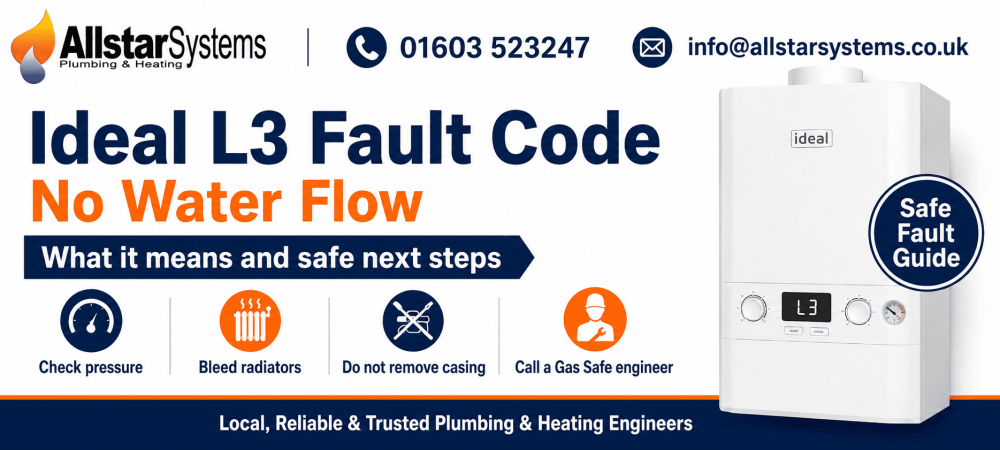
Ideal L3 Fault Code: No Flow Warning, Causes and Safe Repair Advice
An Ideal L3 fault code usually means the boiler has detected poor or no water movement through the heating circuit.
In simple terms, heated water is not moving around the system as it should. When this happens, the appliance may lock out to protect itself from overheating and internal damage.
This warning can affect heating and hot water. However, the cause may be simple, such as low pressure or closed radiator valves. It can also involve trapped air, sludge, pump failure, a blocked heat exchanger, or a sensor issue.
What Does Ideal L3 Mean?
Ideal L3 normally points to a no-flow condition.
The boiler needs steady movement through the heating circuit. This carries heat away from the appliance and into the radiators.
If movement stops or drops too far, the appliance cannot run safely. Therefore, it shuts down and shows the warning.
L3 is not always just a low-pressure issue. Pressure problems can cause it, but so can several other faults.
Is Ideal L3 the Same as Low Pressure?
No, not always.
Low pressure can reduce circulation and trigger the warning. Even so, the gauge might look normal while another issue restricts movement.
For example, air, closed valves, sludge, a stuck pump, or a blocked heat exchanger can all reduce circulation.
Because of this, repeated L3 warnings should be treated as a flow problem, not just a pressure problem.
Common Signs of an Ideal L3 Fault
You may see L3 on the display. Your radiators may stay cold, even when the boiler tries to run.
You may also lose hot water. In addition, the appliance may start briefly, stop, and then lock out.
Gurgling or bubbling sounds can suggest trapped air. Meanwhile, cold areas on radiators can point towards poor circulation or dirty system water.
Common Causes of Ideal L3
Several issues can trigger this warning. Some are safe to check. However, others need a qualified engineer.
Low pressure
Most sealed systems work best around 1 to 1.5 bar when cold. However, always follow your Ideal manual.
If the gauge is too low, circulation can suffer. As a result, the appliance may show L3.
If pressure keeps dropping, do not keep topping up. A leak, expansion vessel issue, or pressure relief valve fault may need repair.
Air in the system
Air pockets can stop water moving freely through radiators and pipework. This can leave radiators cold at the top.
Bleeding radiators may help. However, you must check the gauge afterwards because pressure can fall.
Closed radiator valves
Closed valves can stop enough movement around the heating circuit. This issue often appears after decorating, repairs, or seasonal changes.
Check that enough radiator valves are open. This includes manual valves and thermostatic radiator valves.
Sludge or debris
Sludge, scale, and debris can build up inside pipework and radiators. Over time, this restricts movement and reduces heating performance.
Cold areas at the bottom of radiators often suggest dirty system water. In that case, ask an engineer about cleaning options or power flushing.
Faulty pump
The pump moves heated water around your home. If it sticks, slows, or fails, the appliance can quickly detect poor movement.
Pump faults need professional testing. An engineer can check power, operation, and related wiring.
Blocked heat exchanger
A restricted heat exchanger can stop water passing through correctly. This may cause overheating, lockouts, or poor heating performance.
Do not assume replacement is needed. The part should be tested before any repair decision.
Faulty sensor or thermistor
Some Ideal models rely on sensors to monitor temperature and movement. If a sensor gives poor readings, the appliance may shut down.
An engineer should test the sensor, wiring, and control board before replacing parts.
Bypass issue
Some systems need a bypass route to maintain movement when radiator valves close.
If this route is missing, blocked, or set incorrectly, circulation can suffer. This needs professional assessment.
Safe Checks Before Calling an Engineer
You can complete a few basic checks without opening the boiler.
First, check the pressure gauge when the system is cold. If it sits below the range in your manual, follow the manufacturer’s top-up instructions.
Next, make sure enough radiator valves are open. The boiler should not run with every valve closed.
Then, check radiators for cold spots. If they need bleeding, do this carefully and recheck the gauge afterwards.
After that, try one reset if your Ideal manual allows it. If the warning clears and heating returns, monitor the appliance.
However, if L3 comes back, stop resetting it. Repeated resets will not fix poor circulation, trapped air, sludge, pump failure, or sensor faults.
Should You Check the Gas Isolation Valve?
Some Ideal guidance mentions checking that the yellow gas isolation valve under the boiler has not been turned off.
Only check accessible external controls in line with your manual. Do not remove the boiler casing. Also, do not touch internal gas components.
If you feel unsure, call a qualified engineer.
What to Avoid with Ideal L3
Do not remove the boiler cover. Do not touch wiring, sensors, pumps, gas parts, heat exchangers, or sealed components.
Also, do not keep pressing reset. This can delay the real diagnosis.
Avoid replacing parts based on guesswork. L3 can come from several different causes, so testing matters.
Finally, do not ignore repeated warnings. Poor circulation can damage parts if left unresolved.
When to Call a Gas Safe Engineer
Call an engineer if L3 returns after basic checks. You should also book help if pressure keeps dropping.
In addition, arrange support if radiators stay cold, the boiler makes gurgling noises, or heating keeps cutting out.
A professional can check the pump, pipework, bypass, heat exchanger, sensors, wiring, water quality, and wider circulation route.
This helps find the real cause before parts are replaced.
Can Ideal L3 Damage the Boiler?
L3 protects the appliance by stopping operation. However, the underlying cause still matters.
Poor circulation can make internal parts overheat. Meanwhile, sludge and scale can reduce efficiency and shorten component life.
Prompt diagnosis helps protect the boiler and restore reliable heating.
How to Reduce Future L3 Problems
Annual servicing helps spot early warning signs. During a service, an engineer can check operation, safety, pressure behaviour, and visible component condition.
Clean system water also helps. A magnetic filter and inhibitor can reduce debris and corrosion.
Also, act early if radiators heat slowly, stay cold in places, or make noise. These signs often appear before a full lockout.
Why Choose Allstar Systems?
Allstar Systems helps homeowners with boiler fault diagnosis, repairs, servicing, and heating system care across Norwich and Norfolk.
Our engineers work with gas, oil, LPG, and electric heating systems. Therefore, we can support many property types and setups.
If your Ideal boiler keeps showing L3, our team can check the pressure, radiators, pump, pipework, heat exchanger, bypass, and circulation route.
We provide clear advice before repair work begins, so you understand what caused the problem.
Final Advice on Ideal L3
Ideal L3 usually means the boiler has detected no water flow or poor movement through the heating circuit.
Start with safe checks only. Check the gauge, open radiator valves, bleed radiators if needed, and reset the boiler once.
If the warning returns, book professional help. A qualified engineer can diagnose the fault correctly and restore your heating safely.
FAQS About Ideal L3 Fault Code
What does L3 mean on an Ideal boiler?
L3 on an Ideal boiler means no water flow. The boiler has detected poor or missing water movement through the heating system.
Can I reset an Ideal boiler with an L3 fault?
Yes, you can try one reset after basic checks. However, if the L3 fault returns, contact a Gas Safe registered engineer.
Can low pressure cause an Ideal L3 fault code?
Yes, low pressure can contribute to no water flow. Therefore, check the boiler pressure and follow your Ideal boiler manual.
Why does my Ideal boiler keep showing L3?
A repeated Ideal L3 fault can suggest low pressure, trapped air, closed radiator valves, sludge, a faulty pump, blocked heat exchanger, sensor issue, or circulation problem.
Is an Ideal L3 boiler fault dangerous?
The lockout helps protect the boiler. However, repeated no water flow faults need professional attention because poor circulation can damage parts.
Can I fix an Ideal L3 fault myself?
You can check pressure, open radiator valves, bleed radiators, and reset the boiler once. However, internal testing and repairs need a qualified engineer.
Why are my radiators cold with an Ideal L3 fault?
Cold radiators can suggest trapped air, low pressure, sludge, closed valves, or pump problems. These issues can stop water moving around the system.
How much does it cost to fix an Ideal L3 fault?
The cost depends on the cause. A simple pressure or radiator issue may cost less, while pump, heat exchanger, or sensor faults may cost more.
How can I prevent no water flow boiler faults?
Book annual boiler servicing, keep system pressure correct, maintain clean heating water, and deal with radiator cold spots quickly.