




Potterton E119 Error Code: Causes, Safe Checks and Low-Pressure Advice
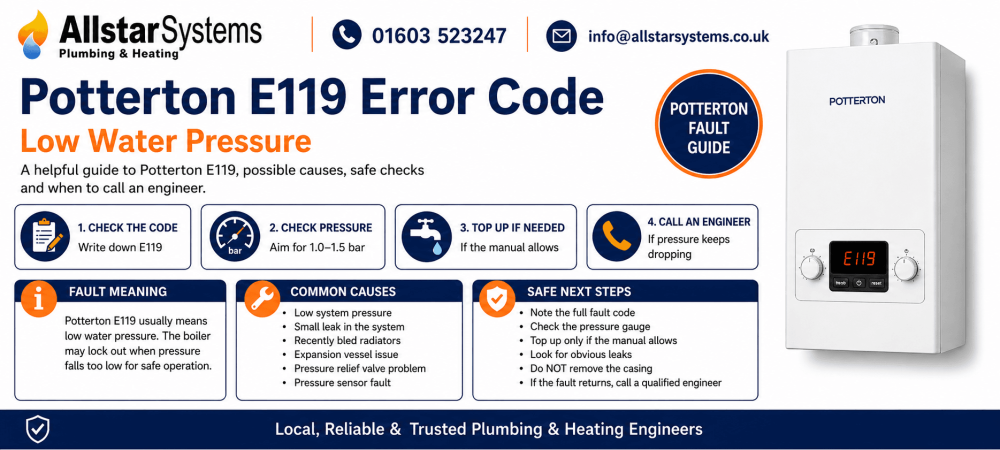
Potterton E119 shows when the boiler detects too little water pressure inside the sealed heating circuit.
When the reading drops too far, the appliance may stop. This protects pumps, seals, and internal parts from poor circulation.
You may lose warmth, hot water, or both. Even so, the first step is simple. Look at the pressure gauge.
What does Potterton E119 mean?
Potterton E119 means the gauge reading has fallen below the safe range for operation.
Most cold heating circuits sit near 1 to 1.5 bar. However, your appliance manual gives the right figure for your exact model.
If the needle sits too low, the boiler may lock out. It does this because water cannot move around the pipework correctly.
So, do not assume a major breakdown straight away. Start with the gauge.
Why does E119 appear?
E119 appears when the appliance notices a low-pressure condition.
Sometimes, this follows normal work, such as bleeding radiators. However, it can also point to water escaping from pipework, a tired valve, or an expansion vessel fault.
A careful top-up may clear the message once. Yet, if the needle falls again, the cause still needs finding.
Common causes of Potterton E119
Gradual loss over time
A sealed circuit can lose a small amount of pressure across many months.
If nobody has topped up the boiler for a long period, the reading may slowly drop below the correct range. In this case, repressurising may solve the warning.
Small leak in the circuit
A hidden drip often causes repeat low-pressure warnings.
Look around radiator valves, towel rails, exposed pipes, and the floor below the boiler. Damp marks, stains, or rust may show where water has escaped.
Even a small leak can make E119 come back.
Radiators recently bled
Bleeding radiators lets trapped air out. However, it also changes the water level inside the circuit.
After bleeding, the gauge may need topping up. Follow your manual and avoid overfilling.
Pressure relief valve problem
The pressure relief valve protects the boiler when the reading climbs too high.
If it fails to seal, water may leave through the discharge pipe. The needle may then fall again after a top-up.
Expansion vessel issue
The expansion vessel helps balance changes as water warms and cools.
If it loses charge or fails, the gauge may climb sharply, then drop too low later. An engineer needs to test this part.
Safe checks before calling an engineer
You can make a few simple checks without opening the appliance.
Look at the gauge
Start with the front gauge.
If the needle sits below the manual’s range, the circuit may need a careful top-up.
Top up only when confident
Many Potterton models use a filling loop.
Open the valves slowly and watch the gauge. Close them fully once the reading reaches the correct level.
Follow your manual exactly. Also, never add too much water.
Look for water marks
Check radiators, valves, pipe joints, towel rails, and the boiler area.
If you see damp patches, rust marks, staining, or dripping water, stop and arrange a repair.
Check radiator valves
A loose bleed valve or leaking radiator valve can cause slow water loss.
If the floor feels damp or the valve looks rusty, the leak needs attention.
Restart once
After restoring the correct level, restart the boiler once if your manual allows it.
If E119 returns, stop resetting. The problem has not been fixed.
Can you clear Potterton E119 yourself?
Sometimes, yes.
A one-off low-pressure message may clear after a careful top-up. You can also look for visible leaks and restart the boiler once.
However, repeat pressure loss needs proper diagnosis.
Do not replace valves, open the casing, or inspect sealed parts. A qualified engineer should test the PRV, expansion vessel, pipework, sensors, and internal components.
When should you call a Gas Safe engineer?
Call an engineer if E119 returns after topping up.
You should also book help if the gauge keeps falling, a leak appears, or the filling loop does not solve the issue.
Also, get support if the boiler keeps locking out, the gauge behaves oddly, or you feel unsure about repressurising safely.
For gas boiler repairs, always use a Gas Safe registered engineer.
How to reduce future E119 warnings
Simple care can lower the risk of repeat pressure problems.
Check the gauge now and then.
Fix visible leaks quickly.
Bleed radiators only when needed.
Top up after bleeding, where required.
Book annual boiler servicing.
Act early when warnings appear.
During a service, an engineer can test safety parts, inspect performance, and spot early wear.
Final thoughts
Potterton E119 means the boiler has detected low pressure in the sealed heating circuit.
Start with the gauge. Then top up only if your manual explains the correct method.
If the warning returns, avoid repeated resets or refilling. Repeat pressure loss often points to a leak, PRV issue, expansion vessel problem, or hidden fault.
A Gas Safe registered engineer can find the cause and restore safe, reliable heating.
Potterton E119 fault code FAQs
What does the Potterton E119 error code mean?
The Potterton E119 error code means the boiler pressure is too low for normal operation.
How do I fix a Potterton E119 fault?
You usually fix it by repressurising the boiler and then resetting it. However, repeated faults need further checks.
What causes low pressure in a Potterton boiler?
Common causes include natural pressure loss, leaks, recently bled radiators, a faulty pressure relief valve, or expansion vessel problems.
Can I reset my boiler after an E119 error?
Yes, once the pressure has been restored to the correct range, you can usually reset the boiler.
Is the Potterton E119 error code serious?
It can be serious if the pressure keeps dropping, as this may point to a leak or faulty internal component.