




Potterton Boiler Fault Codes: Meanings, Causes and Safe Checks
Potterton boilers show fault codes when the appliance detects a problem.
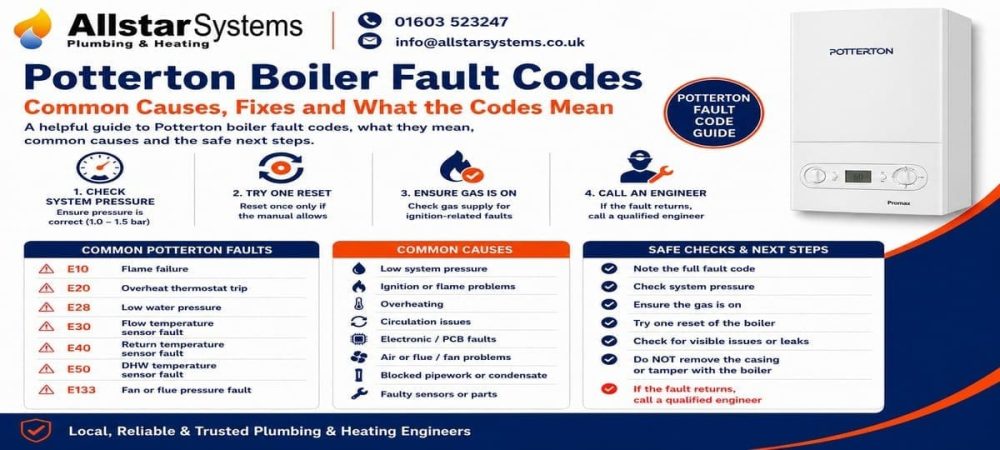
These messages help you understand what may have gone wrong. They can point to low pressure, overheating, ignition failure, poor circulation, sensor trouble, fan faults, or control problems.
Some issues have simple checks. However, many need a Gas Safe registered engineer.
Never remove the casing. Also, do not touch gas parts, flue parts, wiring, the fan, burner, PCB, pump, or internal sensors.
What are Potterton boiler fault codes?
Potterton fault codes are warning messages on the display.
They guide you towards the likely problem area. For example, one message may relate to pressure. Another may suggest ignition, airflow, heat control, or circulation trouble.
Even so, the display does not always give the full diagnosis. It only gives a starting clue.
If the same warning returns after one reset, book professional help.
Common Potterton error codes
E110 means the appliance has reached an unsafe temperature.
This can happen when heat cannot move away from the boiler fast enough. A pump problem, trapped air, blocked pipework, or thermostat issue may be involved.
Possible causes include:
- Poor water movement
- Faulty pump
- Blocked pipework
- Thermostat issue
- Air inside the heating system
If E110 returns after one reset, stop there and call an engineer.
E119 means the boiler pressure has dropped too low. Some Potterton models use E118 for this issue instead.
Low pressure can stop the heating system from running correctly. It may also cause lockouts.
Possible causes include:
- Small leak
- Recent radiator bleeding
- Natural pressure loss
- Expansion vessel issue
- Pressure relief valve fault
You may top up the system if your manual explains how. However, repeated pressure loss needs proper repair.
E125 points to poor water movement through the appliance.
If water cannot move freely, the boiler may overheat or shut down.
Possible causes include:
- Weak pump
- Airlocks
- Sludge build-up
- Blocked pipework
- Closed valves
If radiators heat unevenly, the whole heating circuit may need checking.
E133 means the burner has not lit correctly.
This can happen if the boiler cannot start ignition or cannot prove a flame.
Possible causes include:
- Gas supply issue
- Ignition electrode fault
- Frozen condensate pipe
- Flue issue
- Gas valve problem
Check whether other gas appliances work. If they do not, contact your gas supplier or a qualified professional.
E160 relates to the fan.
The fan helps remove combustion gases. It also supports safe burning.
Possible causes include:
- Failed fan
- Wiring issue
- Obstruction
- Worn part
- PCB signal problem
Do not try internal fan repairs yourself.
E20 – Central heating thermistor issue
E20 points to the central heating thermistor.
This part reads heating water temperature. If the signal becomes wrong, the boiler may struggle to control heat output.
Possible causes include:
- Damaged thermistor
- Loose connection
- Wiring issue
- Sensor failure
If the warning returns, an engineer should test it.
E28 relates to the flue thermistor on many Potterton models.
This part monitors flue gas temperature. Because flue safety matters, you should act quickly.
Possible causes include:
- Damaged sensor
- Incorrect temperature reading
- Wiring issue
- Poor connection
Do not remove flue parts or open the boiler.
E40 points to the return thermistor.
This part reads water temperature as it comes back from the heating circuit.
Possible causes include:
- Failed sensor
- Damaged wiring
- Loose plug
- Poor reading
This small part helps the boiler run efficiently.
E78 suggests a pressure sensor problem.
This component sends pressure readings to the controls. If it reports the wrong value, the boiler may show a warning even when the gauge looks normal.
Possible causes include:
- Faulty sensor
- Poor connection
- Wiring issue
- False reading
An engineer can compare the sensor reading with the actual pressure.
E83, E84 and E85 – Communication issue
E83, E84 and E85 point to a communication fault.
This may involve the room controller, receiver, wiring, electronics, controls, or PCB signals.
However, these messages do not always prove PCB failure. A loose connection or external control fault may also be responsible.
Safe troubleshooting checks
You can make a few simple checks before calling an engineer. However, stop if the same message returns.
For E110 and E125
Check whether radiators heat evenly.
Listen for odd pump noises.
Look for obvious external blockages.
Try one reset only, if the manual allows it.
If the warning returns, arrange professional help.
For E119 or E118
Check the pressure gauge.
Top up only if your manual explains the process.
Look for visible leaks around radiators and pipework.
Watch whether the gauge drops again.
Repeated pressure loss usually means another fault exists.
For E133
Check whether the gas supply is on.
See if other gas appliances work.
Look at the condensate pipe during freezing weather.
Try one reset only.
If ignition still fails, call an engineer.
For E160
Listen for the fan starting.
Note any strange noises.
Look for obvious outside obstructions, where safe.
Do not touch internal fan or flue parts.
For E20, E28 and E40
These messages relate to temperature sensors on many models.
A reset may clear a brief signal issue. However, wiring, plugs, and sensor parts need professional testing if the warning returns.
Do not remove the cover.
For E78
Compare the display with the pressure gauge.
Note whether the reading seems wrong.
Arrange inspection if the warning stays active.
A faulty pressure sensor can create misleading pressure warnings.
For E83, E84 and E85
Note the exact message.
Try one reset only.
Check that external controls have power.
Call an engineer if the warning returns.
Communication problems rarely have a simple home fix.
When should you call an engineer?
Call a Gas Safe registered engineer if the same message returns after one reset.
You should also book help if the boiler overheats, fails to ignite, loses pressure often, shows a fan issue, or stops responding.
If you smell gas, turn off the supply if safe. Then open windows, avoid electrical switches, and call the National Gas Emergency Service on 0800 111 999.
For any internal repair, always use a qualified professional.
How to reduce future Potterton faults
Good care can reduce the risk of sudden breakdowns.
Book annual boiler servicing.
Check the pressure gauge often.
Fix visible leaks quickly.
Bleed radiators when needed.
Top up after bleeding, if your manual says to.
Keep the flue terminal clear.
Act early when warnings appear.
During a service, an engineer can test safety parts, check performance, and spot early wear.
Final thoughts
Potterton fault codes help identify the likely area behind a heating problem.
Low pressure may have safe home checks. However, ignition, overheating, fan, flue, sensor, PCB, and communication problems often need expert diagnosis.
If the same warning returns, stop resetting the boiler. Then arrange a professional inspection.
Fast action helps restore safe, steady, and reliable heating.
Potterton Boiler Fault Codes FAQs
What are Potterton boiler fault codes?
Potterton boiler fault codes are error messages that help identify a problem within the heating system.
What does E133 mean on a Potterton boiler?
E133 means ignition failure. Therefore, the boiler did not light correctly.
Is E110 on a Potterton boiler serious?
Yes, it can be serious because it means the boiler has overheated.
Can I reset a Potterton boiler myself?
Yes, you can usually try one reset. However, repeated resets should be avoided.
What should Potterton boiler pressure be?
Most domestic boilers work best at around 1 to 1.5 bar when cold. Always check your manual for the correct range.