




Baxi E125 Error: Why Radiators Stop Warming and What To Check
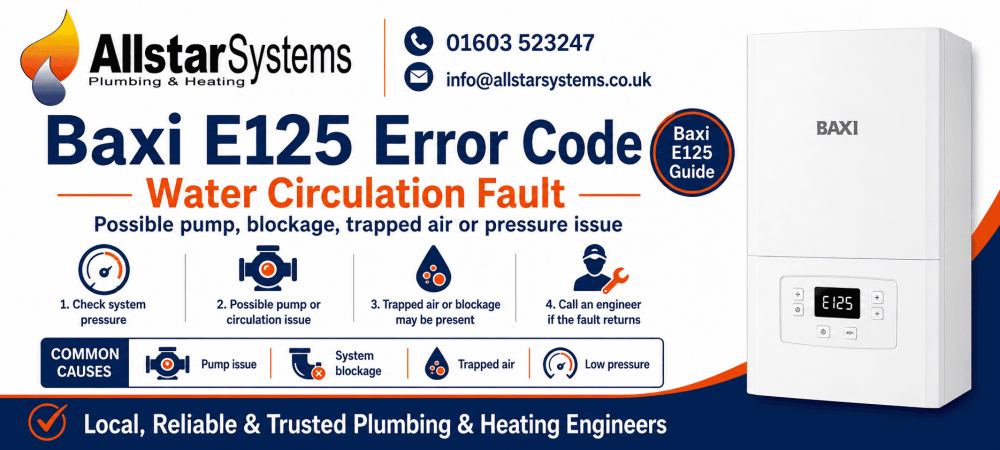
A Baxi E125 error often appears when warm water is not travelling through the heating circuit as it should.
In simple terms, the appliance expects steady movement through the radiators and pipework. If that movement slows or stops, the display can show E125.
This is not only a low-pressure issue. Instead, it can involve air, sludge, a weak pump, a blockage, or an internal component.
What does E125 mean?
E125 points to poor movement inside the heating circuit.
The appliance needs water to move freely so heat can reach each room. When that path becomes restricted, the system may shut down.
As a result, radiators may stay cold, warm unevenly, or take too long to heat.
Why does E125 appear?
Low gauge reading
If the gauge reading is too low, the system may struggle to move water. So, check this first.
However, a normal reading does not rule out other problems.
Weak pump performance
The pump pushes water around the heating circuit. If it sticks, slows, or becomes blocked, heat will not travel properly.
Trapped air
Air pockets can stop radiators heating well. You may hear gurgling sounds or notice cold areas at the top.
Sludge inside the system
Over time, dirty water could leave sludge in radiators, valves, and pipework. This can restrict flow and reduce heating performance.
Closed or restricted valves
A closed radiator valve or hidden restriction could limit water movement. This may cause poor heat output and repeat lockouts.
Internal fault
Sometimes, the cause sits inside the appliance. It could involve wiring, sensors, the pump, or another internal part.
Is E125 the same as low pressure?
No. E125 mainly points to poor movement through the heating circuit.
Low pressure can contribute. However, topping up will not fix trapped air, sludge, a blocked pipe, or a sticking pump.
So, treat the gauge as one clue. Do not use it as the full diagnosis.
Safe checks before booking a repair
First, write down the code shown on the display. Also, note when it appears.
Next, check the gauge while the system is cold. Compare the reading with your Baxi manual.
If the reading sits low, follow your manual for topping up. Add water slowly and stop at the correct range.
After that, check your radiators. Cold tops, noise, or slow heating can suggest trapped air or poor flow.
Then, make sure visible radiator valves are open.
You may try one reset if your manual allows it. If E125 returns, stop there.
What should you avoid?
Do not remove the case.
Inside, there are gas parts, electrical components, sealed areas, hot surfaces, and moving parts.
Also, do not test the pump, wiring, sensors, internal pipework, or sealed parts yourself.
Do not keep resetting the appliance. This can hide the cause and delay the correct repair.
Can sludge cause E125?
Yes. Sludge can reduce movement through the system.
Common signs include cold radiator patches, slow warm-up, noisy operation, and repeated lockouts.
An engineer can check whether the system needs cleaning, flushing, balancing, or another repair.
Can you fix E125 yourself?
Sometimes, but only in simple cases.
If the gauge reading is low, you may be able to top up the system by following your manual.
If radiators contain air, you may also be able to bleed them safely.
However, if the warning returns, stop there. The cause may involve the pump, sludge, a blockage, wiring, sensors, or another internal issue.
When should you call an engineer?
Call an engineer if E125 returns after one reset.
Also, book help if the gauge keeps dropping, radiators stay cold, or the appliance makes unusual noises.
You should also arrange support if heating performance keeps getting worse.
A Gas Safe registered engineer can test water movement, pump operation, wiring, sensors, air locks, sludge, and restrictions safely.
Why proper diagnosis matters
E125 can look like a quick top-up job. However, the real cause often sits deeper.
If sludge blocks pipework, adding water will not solve it. If the pump sticks, resetting will not restore reliable flow.
Proper diagnosis helps avoid guesswork. It also reduces repeat breakdowns and needless part changes.
Can servicing reduce future E125 issues?
Annual servicing cannot prevent every fault. However, it can help spot weak circulation, pump wear, falling readings, and unsafe operation early.
During a service, an engineer checks how the appliance starts, runs, and shuts down.
Between services, act early if radiators heat slowly, make noise, or stay partly cold.
Does E125 mean replacement is needed?
Not usually. E125 often relates to a repairable heating issue.
The cause may be low water, trapped air, sludge, pump trouble, blocked pipework, wiring, or a sensor fault.
However, replacement may be worth discussing if the appliance is old, unreliable, or costly to maintain.
Need help with a Baxi E125 error?
A Baxi E125 error usually means warm water is not moving through the heating circuit as expected.
Start with safe checks only. Note the code, check the gauge, review your manual, inspect radiator performance, and try one approved reset.
Then, if the warning returns, arrange a visit from a Gas Safe registered engineer.
Need reliable heating diagnostics, servicing, or repairs? Contact us today for expert support.
Baxi E125 Fault Codes FAQS
What is the Baxi E125 error code?
The Baxi E125 error code means the boiler has detected a primary circulation fault. In short, water is not moving properly.
Can low pressure cause a Baxi E125 fault?
Yes, low pressure can affect water circulation. Therefore, it may contribute to the E125 error code.
Can I reset my boiler after an E125 code?
Yes, you can try a reset after basic checks. However, repeated faults need professional diagnosis.
Does E125 mean I need a new boiler?
No, not always. In many cases, the issue involves pressure, airlocks, sludge, or a pump problem.
Is Baxi E125 dangerous?
It can lead to overheating if ignored. Therefore, you should deal with it quickly and safely.
Who should fix a Baxi E125 error?
A Gas Safe registered engineer should inspect and repair any internal boiler fault.