




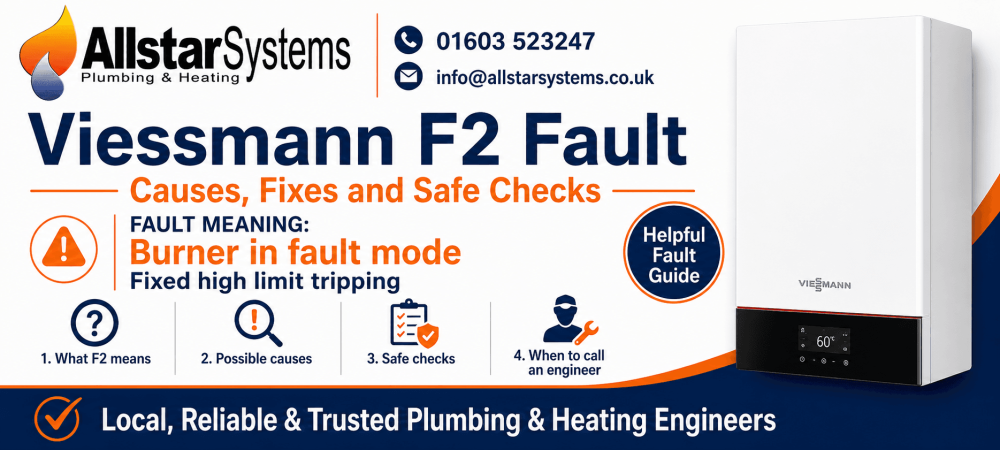
Viessmann F2 Error: What It Means and What To Do Safely
A Viessmann F2 error often appears when the unit has reached a safety temperature limit. In plain terms, it has become too hot or cannot move warmth away fast enough.
This warning stop your heating and hot water. However, the exact meaning could vary by model. So, always use your own manual as the main guide.
Some simple checks are safe. Yet, you should leave anything inside the case to a Gas Safe registered engineer.
What does the F2 display mean?
The F2 display usually points to an over-temperature safety trip.
On some Viessmann models, it means the burner has stopped because the fixed high limit has operated. This could happen when warmth builds faster than the system can remove it.
As a result, the unit may lock out. This protects key parts from damage and prevents unsafe running.
However, do not treat F2 as a reset-only problem. If it returns, the cause needs proper diagnosis.
Why can the F2 display appear?
Low pressure or water level
A sealed system needs enough water to move warmth around your home. If the level drops, flow can suffer. Consequently, the unit may stop for safety.
Restricted flow
Radiator sludge, closed valves, trapped air, or a blockage can slow movement through the circuit. As a result, temperatures can rise too quickly.
Pump trouble
The pump moves heated water through the pipework. If it sticks, slows, or fails, warmth can build inside the unit.
Air in the pipework
Air pockets can cause gurgling sounds and cold radiator sections. Also, they can reduce movement through the circuit.
High-limit or cable issue
The fixed high limit and its cable form part of the safety chain. If either one has a problem, the unit may shut down.
Blocked heat exchanger
A restricted exchanger can stop heat transfer. In some cases, dirty system water may contribute.
What can you check safely?
First, note the exact code on the display. Also, write down when it appeared.
Next, check the pressure gauge if your model has one. Then, compare the reading with your manual.
After that, think about recent radiator bleeding. Pressure can drop afterwards, so the system may need topping up.
You can also listen for clues. Gurgling, slow warm-up, or cold radiator areas can suggest poor flow.
Then, check your manual for the correct reset process. Only try one reset if the instructions allow it.
If F2 returns, stop resetting the unit. Repeated resets will not solve pump faults, air locks, cable issues, or over-temperature causes.
What should you avoid?
Do not remove the outer case. Inside, there are electrical parts, sealed sections, and gas-related components.
Also, do not test the pump, limiter, wiring, burner, or control parts yourself. These checks need proper tools and qualifications.
Do not keep topping up pressure without finding the reason for pressure loss. Frequent filling can suggest a leak or another hidden fault.
Can you fix F2 yourself?
Sometimes, you may solve a simple pressure-related issue by following your manual.
For example, you may restore pressure after radiator bleeding. You may also complete one reset.
However, if the warning returns, stop there. The problem may involve the pump, fixed high limit, wiring, trapped air, blocked parts, or poor flow.
At that point, book a trained heating professional.
When should you call an engineer?
Call an engineer if F2 returns after one reset. Also, arrange help if pressure will not stay steady.
You should also get support if the unit overheats again, locks out repeatedly, or stops producing heating and hot water.
Likewise, book a repair if radiators stay cold, make noise, or warm very slowly. These signs can point towards poor flow.
An engineer can test pressure, water movement, pump operation, the high-limit safety device, cables, and heat transfer. Therefore, they can find the cause without guesswork.
Can servicing help prevent F2 issues?
Regular servicing cannot prevent every fault. However, it can help find early signs of poor flow, leaks, wear, or unsafe running.
During a service, an engineer can check key safety functions and assess how well the unit runs. They may also spot warning signs before a full lockout occurs.
Good maintenance becomes more important as a system gets older. Additionally, it can help reduce surprise breakdowns during colder weather.
Need help with a Viessmann F2 error?
A Viessmann F2 error often relates to an over-temperature shutdown or poor flow. Common causes include low pressure, trapped air, pump trouble, high-limit problems, wiring issues, or a restricted exchanger.
Start with safe checks only. Check the manual, pressure gauge, recent bleeding, and one model-approved reset.
Then, if the code returns, contact a Gas Safe registered engineer for proper diagnosis and repair.
Need reliable heating diagnostics, servicing, or repairs? Contact us today for expert support.
Viessmann F2 Fault FAQs
What does the Viessmann F2 fault mean?
The Viessmann F2 fault usually means the burner is in a fault state because the temperature limiter has responded. In simple terms, the boiler has detected a temperature safety issue and has locked out to protect itself.
What causes a Viessmann F2 fault code?
Common causes include low system pressure, poor circulation, trapped air, a faulty circulation pump, blocked pipework, sludge, or a temperature limiter issue. However, the exact cause can vary by Viessmann boiler model.
Is the Viessmann F2 fault an overheating fault?
Yes, in many cases, the Viessmann F2 fault relates to an overheating or high-temperature safety condition. However, it is best to describe it as a temperature limiter fault because that matches manufacturer wording more closely.
Can low boiler pressure cause a Viessmann F2 fault?
Yes, low boiler pressure can contribute to a Viessmann F2 fault. If the system does not have enough water pressure, heat may not move around the heating circuit correctly.
What pressure should my Viessmann boiler be?
Viessmann says boiler pressure is usually around 1 to 1.5 bar. However, always check your own boiler manual because the correct pressure can vary by model.
Can trapped air cause a Viessmann F2 boiler fault?
Yes, trapped air can reduce water circulation. As a result, the boiler may heat up too quickly and trigger the F2 fault code.
Can a faulty pump cause the Viessmann F2 fault?
Yes, a faulty or stuck circulation pump can cause poor water movement. Consequently, the boiler may overheat and lock out with an F2 fault.
Can sludge cause a Viessmann F2 fault code?
Yes, sludge and debris can restrict circulation through radiators, pipework, hoses, or the heat exchanger. Therefore, the boiler may struggle to move heat away safely.
Can I reset a Viessmann F2 fault myself?
You can try one reset if your Viessmann manual allows it. However, if the F2 fault returns, stop resetting and contact a qualified heating engineer.
What safe checks can I try before calling an engineer?
Check the boiler pressure, make sure radiator valves are open, check your heating controls, and listen for gurgling noises. Also, note the exact fault code before resetting the boiler once.
Should I bleed radiators with a Viessmann F2 fault?
You can bleed radiators if they have cold spots at the top. However, check the boiler pressure afterwards because bleeding radiators can lower system pressure.
Could a blocked heat exchanger cause Viessmann F2?
Yes, a blocked or restricted heat exchanger can reduce heat transfer. As a result, the boiler temperature may rise too quickly and trigger a safety lockout.