



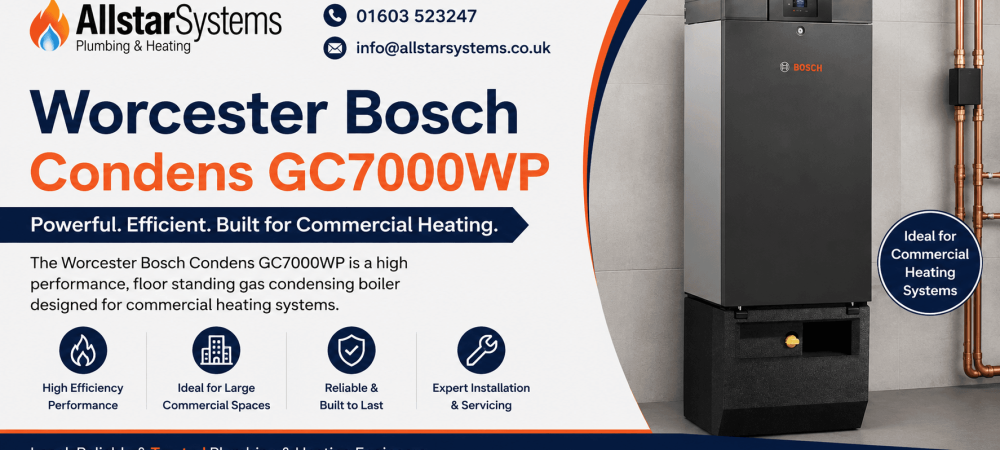
Worcester Bosch Condens 7000 WP for Larger Buildings
Selecting heating plant for a larger property needs more than a quick output match. The design must suit the site, the way people use it, and the space available for installation and future care.
The Worcester Bosch Condens 7000 WP range gives engineers a high-output option for demanding settings. It may suit larger homes, residential blocks, managed premises and some commercial plant rooms.
Even so, the model should never be chosen by name alone. A proper review should look at heat loss, fuel capacity, flue route, controls, water condition, access and downtime risk.
Overview of the Condens 7000 WP Range
The Condens 7000 WP is a high-output condensing range from Worcester Bosch. It suits projects where a standard domestic appliance may not provide enough capacity.
Depending on the site, it can work as one unit or as part of a linked cascade arrangement. That gives designers more flexibility when heat demand changes during the day.
Typical output options include:
- 50kW
- 65kW
- 85kW
- 100kW
- 125kW
- 145kW
These choices give useful range. However, sizing should always come from calculation, not guesswork.
Why Early Design Work Matters
Large buildings often have mixed heating patterns.
A school might need fast morning warm-up. An office may need steady comfort through set hours. A care setting may need a more constant indoor temperature.
Because of this, engineers should assess the whole site before specifying equipment.
Important checks include:
- heat loss
- daily operating hours
- hot water demand
- plant-room layout
- fuel supply
- flue route
- zoning
- pump setup
- water condition
- expansion needs
- safe access
- future building plans
This approach helps avoid poor sizing. It also reduces the risk of waste, short cycling or weak winter performance.
How Cascade Design Works
A cascade layout connects several units under shared control.
During light demand, only part of the setup runs. When the building needs more heat, extra units join in. This helps output follow demand more closely.
Cascade design can support:
- flexible output
- better load matching
- part-load efficiency
- stronger resilience
- easier maintenance planning
- future expansion
- staged heat delivery
Worcester Bosch states that Condens 7000 WP units can operate in banks of up to six. It also notes that multiple MC400 sequencers can manage up to 16 units.
However, this type of layout needs careful planning. Pipework, hydraulics, pumps, condensate drains, flues, controls and service space all matter.
Installation Options and Plant-Room Fit
The Condens 7000 WP range can suit wall-mounted or floor-mounted layouts, depending on the site and model.
This flexibility may help in tight plant rooms or refurbishment projects. Yet good access still matters. Engineers need clear space for maintenance, inspection and future replacement.
A compact layout only works well when the room still allows safe servicing. Therefore, flue routes, drainage, lighting, pipework and isolation points should form part of the design from the start.
Where This Range May Fit
The Condens 7000 WP may suit buildings with higher or more complex heat demand.
Possible settings include:
- large private homes
- residential blocks
- schools
- offices
- retail spaces
- care settings
- hospitality sites
- community buildings
- managed properties
- light commercial premises
Still, similar buildings can perform very differently. Glazing, insulation, ceiling height, opening hours, extensions and zoning all affect heat demand.
So, the building should guide the choice. The product should not lead the decision.
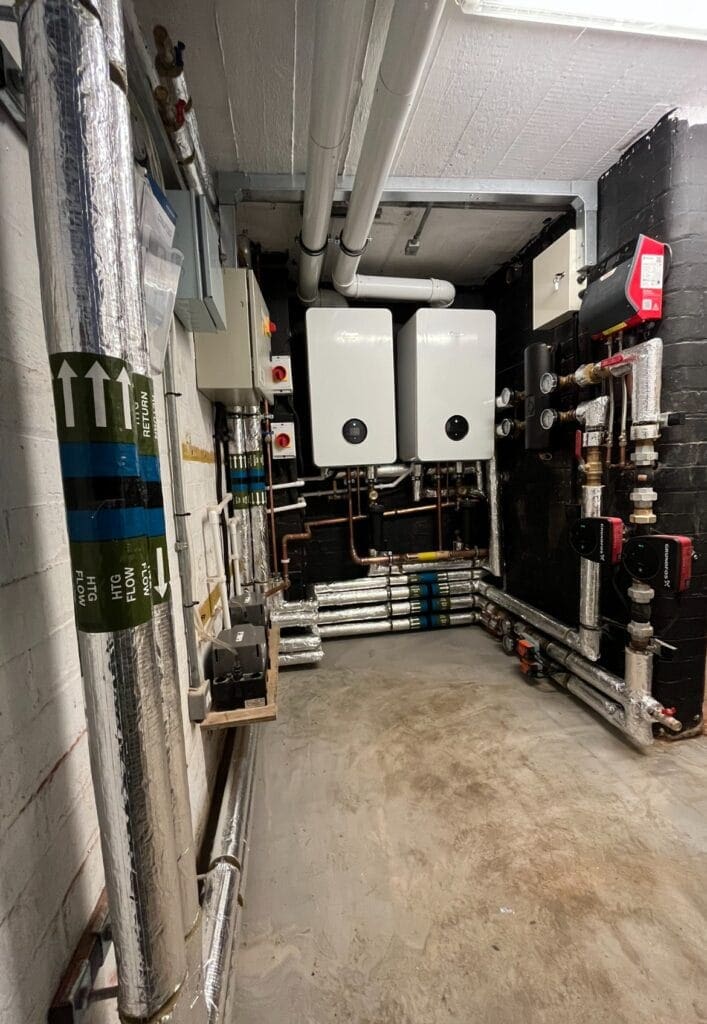
Larger Homes and Residential Projects
Some homes need more capacity than a typical domestic setup can offer.
This could happen in properties with high ceilings, several heating zones, extensions, outbuildings, large rooms or strong heat loss.
However, larger equipment does not always bring better comfort. In some cases, a well-sized domestic solution may work better.
Before choosing this range, an engineer should review pipework, radiators, cylinders, pressure, controls, fuel supply and future plans.
Managed and Commercial Sites
Managed buildings often need heat across different spaces at different times.
Schools may need strong output before pupils arrive. Offices may need zoned warmth through working hours. Hospitality sites may need comfort and hot water across longer trading periods.
The Condens 7000 WP may suit some of these projects. Yet another wall-hung model, floor-standing plant or separate hot water solution may fit better.
The right choice depends on the real site conditions.
Fuel Supply and Flue Route
Fuel supply and flue planning can make or break the project.
A model may look right on paper. However, the existing supply, pipe size or flue route may not support the final design.
Before installation, an engineer should review:
- meter capacity
- pipe sizing
- terminal position
- flue path
- condensate route
- ventilation
- manufacturer clearances
- commercial standards
- future service access
These checks become even more important when several units operate together.
Controls and Daily Use
Controls shape how well the system works after installation.
Some sites only need simple time settings. Others need zoning, weather compensation, hot water priority, pump control, BMS links or fault monitoring.
In a cascade design, sequencing also matters. The control setup decides which unit fires first and how output rises or falls.
Good heating controls reduce waste and improve comfort. Poor settings can make strong equipment feel disappointing.
Water Condition and Protection
Old heating systems often contain sludge, rust, scale or debris.
If dirty water remains, new plant may suffer. Flow can reduce, parts can wear sooner and efficiency can drop.
Before installation, an engineer may recommend:
- water testing
- flushing
- dirt separation
- magnetic filtration
- inhibitor treatment
- pump checks
- strainer checks
- balancing
- commercial power flushing
This protects the new equipment and supports better long-term performance.
Access for Servicing
Future care should shape the plant-room layout.
Engineers need safe access to the front of the unit, flues, pumps, valves, controls, condensate drainage and isolation points.
The room should also have enough light and working space.
Poor access makes service visits harder. It can also slow repairs and raise costs later.
Warranty and Current Requirements
Warranty terms can change. Therefore, always check the latest Worcester Bosch requirements before purchase.
Cover could depend on correct installation, proper commissioning, water condition, approved controls, routine servicing, accurate records and genuine parts.
Do not rely on old brochures or copied online notes. Current manufacturer guidance should lead the decision.
Temporary Heat During Works
Replacement or plant-room refurbishment can take heat offline.
For schools, offices, care homes, hospitality venues and managed properties, downtime can cause serious disruption.
Temporary heating may be useful during planned replacement, emergency failure, upgrade works, maintenance or winter pressure.
This should be discussed early. It is much easier to plan before the existing system stops.
When Another Option Makes More Sense
The Condens 7000 WP will not suit every project.
Another model may be better if the site needs different output, floor-standing plant, a separate hot water strategy, unusual hydraulics or a different flue arrangement.
Limited access, future expansion plans and fuel restrictions may also change the decision.
A good review should compare options before any final choice.
Key Questions Before Choosing
Before selecting this range, ask:
- What is the building’s heat load?
- Is the current setup too large or too small?
- Would linked units improve performance?
- Does the plant room suit the layout?
- Can the fuel supply support demand?
- Is the flue route practical?
- Are controls suitable?
- Does the system need cleaning first?
- Is water condition acceptable?
- Can engineers service it safely?
- What warranty terms apply now?
- Will downtime affect the site?
- Is temporary heat needed?
- Would another model work better?
These questions reduce risk before work starts.
Need Commercial Heating Advice?
If you manage a larger building, get professional advice before choosing new heating plant.
A qualified engineer can assess demand, access, fuel supply, flue planning, controls, water condition and future care needs.
This gives a clearer answer on whether the Worcester Bosch Condens 7000 WP suits the property, or whether another option would offer better value.
FAQs About Worcester Bosch Condens 7000 WP Boilers
What is the Worcester Bosch Condens 7000 WP?
The Worcester Bosch Condens 7000 WP is a wall-mounted gas condensing boiler range for larger domestic, residential and commercial heating systems.
What outputs are available for the Condens 7000 WP?
Worcester Bosch installer literature lists 50, 65, 85, 100, 125 and 145kW output options.
Can Condens 7000 WP boilers be installed in cascade?
Yes. Worcester Bosch says the range can be cascaded in banks of up to six boilers per bank.
What output can a Condens 7000 WP cascade provide?
Worcester Bosch installer guidance says a bank of up to six boilers can provide up to 858.6kW at 50/30 per bank.
Can more than six Condens 7000 WP boilers be linked?
Bosch Commercial states that multiple MC400 control sequencers can link up to 16 boilers.
Is the Condens 7000 WP wall-mounted or floor-mounted?
Worcester Bosch describes the range as flexible, with wall-hung or floor-mounted installation options depending on the project.
Is the Condens 7000 WP suitable for commercial buildings?
It may suit some commercial and managed buildings. However, suitability depends on heat load, plant-room layout, gas supply, flue route, controls and access.
Can a Condens 7000 WP boiler be used in a large home?
Sometimes. Larger homes with higher heating demand may suit this type of boiler, but a heat-loss assessment should confirm this.
Why does water quality matter with this boiler?
Poor water quality, sludge and corrosion can affect performance, reliability and efficiency. Therefore, system condition should be checked before replacement.
Who should install a Condens 7000 WP boiler?
A suitably qualified commercial heating engineer should install, commission and service the boiler in line with manufacturer instructions and relevant regulations.