




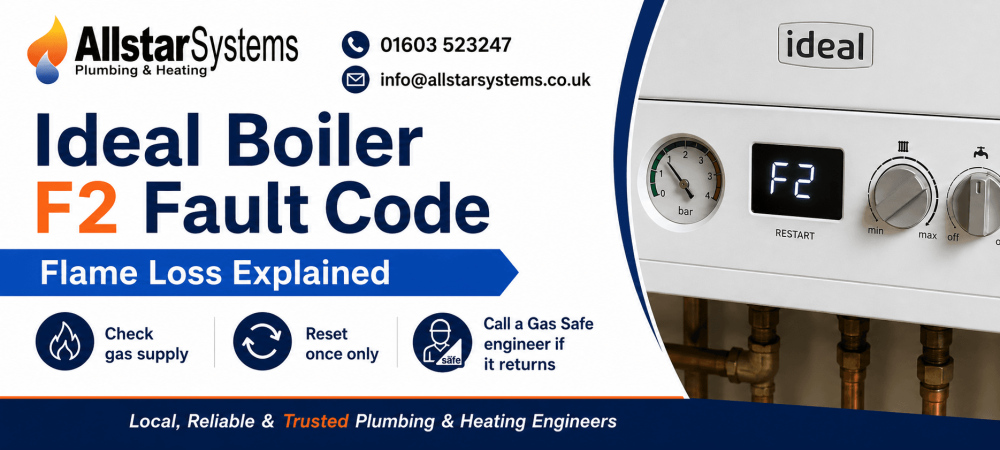
Ideal F2 Fault Code: Flame Loss and Safe Next Steps
An Ideal F2 fault code usually means the heating unit has lost its flame or failed to light correctly.
When this happens, the appliance normally shuts down. This lockout protects the property, although it may leave you without heating, hot water, or both.
Sometimes, the cause is simple. A prepayment meter may need credit. Alternatively, the supply may have been turned off. In other cases, the issue may involve ignition parts, flame sensing, the flue, condensate drainage, or another internal component.
Because this warning links to combustion safety, do not remove the case. A Gas Safe registered engineer must handle any work inside the unit.
What the F2 Code Means
On many Ideal Logic, Logic Max, Logic+ and related models, F2 points to flame loss or ignition lockout.
In plain terms, the unit tried to light or keep a steady flame. However, it could not confirm safe operation. So, it stopped running and showed the warning code.
This does not automatically mean replacement is needed. However, it does mean the cause needs checking if the code returns.
You may follow the user manual for one reset. Yet repeated resets should not replace proper diagnosis.
Models That May Show This Warning
Several Ideal ranges can display this code, including:
- Ideal Logic combi models
- Ideal Logic system models
- Ideal Logic Max ranges
- Ideal Logic+ models
- some Ideal Vogue models
- some related Ideal ranges
Each model can differ slightly. Therefore, check your own manual before taking action.
If you contact an engineer, give the make, model and display code. This helps them understand the likely issue before visiting.
Why Flame Loss Needs Care
A heating appliance must light safely and prove a stable flame. If it cannot do that, it should stop.
This lockout prevents unsafe running. It also tells you that something has interrupted start-up or flame detection.
The cause may sit outside the appliance, such as a closed supply valve or empty prepayment meter. However, it may also sit inside the case, where only a qualified engineer should investigate.
Safe Checks Before You Book a Repair
You can make a few simple checks from outside the unit.
Check whether the display shows F2. Then see whether other fuel-burning appliances in the property still work.
If you use a prepayment meter, check the credit. Also, check whether the yellow isolation valve below the unit appears open.
Listen for gurgling during start-up. Look for water nearby. Finally, note any unusual smells or safety concerns.
Do not remove covers. Do not touch sealed parts. Do not work on the flue, burner, valve, wiring, or internal components.
If you smell gas, leave the property and call the National Gas Emergency Service on 0800 111 999. Do not use switches, plugs, flames, or electrical items.
Should You Press Reset?
Ideal guidance may allow a reset for this code. However, only do this if the manual explains the process clearly.
One reset may clear a temporary lockout. However, the same warning returning means the appliance still has a fault.
Do not keep pressing reset. This can delay diagnosis and may hide a safety issue.
Also, avoid resetting the unit if you smell gas, hear unusual noises, see water nearby, or feel unsure.
What If Other Appliances Have Stopped Working?
If your hob, fire, or other fuel-burning appliance has stopped too, the issue may involve the property supply.
Check your meter credit first. Then check whether the main control valve has been turned off.
A local supply interruption may also cause problems. If you remain unsure, contact your supplier or a qualified engineer.
If there is any smell of gas, treat it as an emergency and leave the building.
Could the Isolation Valve Be Off?
Ideal troubleshooting often mentions the yellow isolation valve below the appliance.
When open, the handle usually sits in line with the pipe. When closed, the unit will not receive the fuel it needs to light.
You can look at the valve position. However, do not dismantle anything.
If you are unsure, stop there and arrange professional help.
Could a Frozen Condensate Pipe Be Involved?
Cold weather can affect the condensate pipe, especially when it runs outside.
If the pipe freezes or blocks, the appliance may struggle during start-up. Gurgling or bubbling sounds can point towards drainage trouble.
Even so, this warning does not always come from condensate problems. Therefore, follow the manual or ask an installer before taking action.
Do not open the unit to inspect it.
Common Causes of This Warning
The display code tells you there is a flame or ignition problem. It does not name the failed part.
Possible causes include:
- interrupted supply
- empty prepayment meter
- closed isolation valve
- frozen condensate pipe
- ignition electrode fault
- flame sensor fault
- faulty valve
- fan or airflow problem
- restricted flue
- burner issue
- wiring fault
- PCB fault
- lack of servicing
- incorrect supply pressure
- age-related wear
Many of these faults involve safety-critical parts. So, they need a Gas Safe registered engineer.
If the Code Returns After Reset
A returning warning means the cause remains unresolved.
Do not keep restarting the heating unit. Instead, arrange a proper test.
Repeat lockouts may point to ignition failure, flame sensing trouble, condensate blockage, flue restriction, wiring faults, valve failure, or worn parts.
An engineer can test the appliance safely and confirm the repair route.
Is This Fault Dangerous?
The lockout itself is a safety feature. It means the appliance has stopped because it cannot confirm safe flame operation.
However, flame-related faults should always be treated with care.
Leave the property if you smell gas, suspect fumes, or feel unwell near the appliance. Then call the emergency number.
If there is no emergency, but the warning keeps returning, book a Gas Safe registered engineer.
What to Avoid
- Do not remove the casing.
- Do not touch internal parts, adjust the valve, alter the flue, or interfere with the burner.
- Do not keep pressing reset.
- Do not ignore gurgling sounds, water near the unit, or repeated lockouts.
- Do not follow risky online repair advice.
- Do not assume a new heating appliance is needed before diagnosis.
Homeowners should only use the manual and check external items.
Can Servicing Reduce Future Faults?
Regular boiler servicing cannot prevent every breakdown. However, it can reveal wear, poor condition, blocked areas, seal issues and early performance concerns.
During a service, an engineer may check visible condition, flue route, safety devices, seals, combustion performance, supply pressure and general operation.
This gives you a clearer view before small issues become major faults.
When to Call a Gas Safe Registered Engineer
Call an engineer if the warning remains after safe checks or returns after one reset.
You should also book help if:
- the unit will not ignite
- the flame cuts out
- other fault codes appear
- gurgling continues
- the property supply seems fine
- there has not been a recent service
- you smell gas
- you feel unsure
A qualified engineer can test the unit, confirm the cause and explain your repair options.
Does This Mean You Need a New Unit?
Usually, no.
This fault often relates to a repairable issue. Common causes include ignition failure, flame sensor problems, condensate blockage, valve faults, or supply issues.
Replacement may only make sense if the appliance is very old, unreliable, or costly to repair.
Before deciding, get a clear diagnosis. This avoids replacing working equipment when a repair may solve the problem.
Need Help With an Ideal F2 Fault?
If your Ideal unit shows F2, start with safe external checks. Confirm meter credit, supply, valve position and manual reset steps.
If the warning returns, stop resetting the appliance. Contact a Gas Safe registered engineer for a full inspection and safe repair advice.
FAQs About the Ideal Boiler F2 Fault Code
What does F2 mean on an Ideal boiler?
F2 usually means flame loss or ignition lockout. The boiler has not confirmed a safe, stable flame, so it has stopped running.
Can I reset an Ideal boiler with an F2 fault?
You can follow the reset instructions in your boiler manual. However, if F2 returns, do not keep resetting the boiler.
Why does my Ideal boiler show F2?
Possible causes include gas supply issues, no meter credit, a closed gas isolation valve, condensate blockage, ignition faults, flame detection faults or internal boiler problems.
Should I check other gas appliances?
Yes. If other gas appliances are also not working, the issue may involve the gas supply rather than the boiler.
Can no gas credit cause an F2 fault?
Yes. Ideal advises checking credit if you have a pay-as-you-go gas meter.
Can a condensate blockage cause F2?
It can contribute to boiler firing problems. Ideal advises contacting your installer if the boiler makes gurgling or gargling noises while trying to fire.
Is an Ideal F2 fault dangerous?
The fault is a safety lockout. However, flame-related faults should be taken seriously. If you smell gas or feel unsafe, leave the property and call the emergency gas service.
Can I fix an F2 fault myself?
Homeowner checks should stay limited to visible external checks and a manual-guided reset. Internal boiler repairs need a Gas Safe registered engineer.
Does F2 mean my boiler needs replacing?
Not usually. Many F2 faults can be repaired. However, replacement may be worth considering if the boiler is old, unreliable or repeatedly failing.
When should I call an engineer for an Ideal F2 fault?
Call an engineer if F2 returns after a reset, the boiler will not ignite, the fault keeps happening, or you are unsure what caused it.