




Worcester Bosch U1 Fault Code: High Flow Temperature and Safe Repair Advice
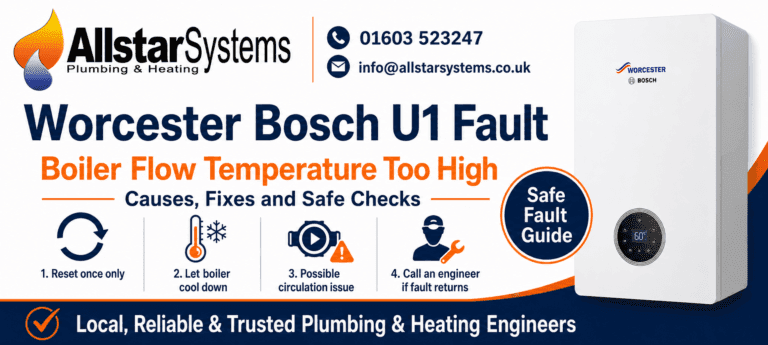
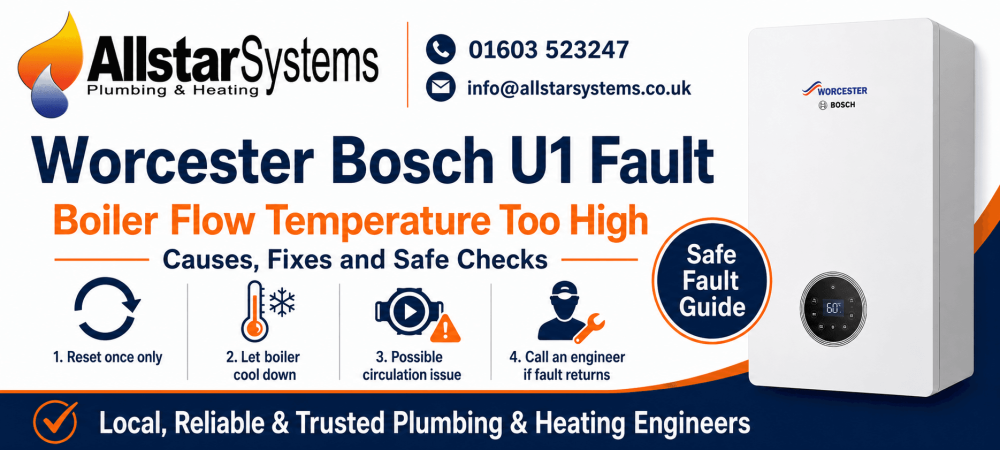
A Worcester Bosch U1 fault code usually means the boiler has sensed that the flow temperature is too high. On many Greenstar models, the appliance pauses until it cools to a safer level.
This often happens when heat cannot move away from the boiler quickly enough. As a result, radiators may stay cold, hot water may fail, or the system may shut down.
Although U1 protects the appliance, it still needs attention if it returns.
What Does Worcester Bosch U1 Mean?
Worcester Bosch U1 points to a high-temperature reading on the flow side of the heating circuit.
The flow side is where heated water leaves the boiler and moves towards radiators or a cylinder. If that movement slows, heat builds up fast.
This may happen because of low pressure, trapped air, closed valves, dirty system water, a weak pump, a restricted heat exchanger, or a faulty sensor.
Is U1 an Overheat Fault?
Not exactly.
U1 relates to the temperature of the water leaving the appliance. Worcester Bosch guidance says the boiler can shut down until it has cooled.
If the temperature rises very quickly, poor circulation may be the real cause.
So, U1 is close to an overheat warning, but it often points towards a movement problem in the wider heating circuit.
Common Signs of Worcester Bosch U1
You may see U1 on the display. Heating may stop, and hot water may become unreliable.
The boiler may run for a short time, then switch off. Some radiators may warm quickly, while others remain cool.
You may also hear gurgling, bubbling, humming, or kettling. These sounds often suggest trapped air, sludge, or restricted movement.
Common Causes of Worcester Bosch U1
Several issues can trigger this message. Most involve pressure, flow, blockage, or temperature control.
Low pressure
Low pressure can reduce water movement around the heating circuit.
Many sealed systems sit around 1 to 1.5 bar when cold. However, always follow your Worcester Bosch manual.
If the gauge keeps falling, a leak, expansion vessel issue, or pressure relief valve problem may need repair.
Trapped air
Air pockets can stop water moving freely through radiators and pipework.
Cold areas near the top of radiators often point to trapped air. Bleeding may help, but you should check the gauge afterwards.
Closed radiator valves
If too many valves are shut, heat cannot leave the boiler properly.
Check that enough manual and thermostatic radiator valves are open before trying a reset.
Sludge or debris
Dirty system water can restrict radiators, pipework, and key components.
Cold areas at the bottom of radiators often suggest sludge. In that case, ask an engineer about cleaning, inhibitor, or power flushing.
Weak pump
The pump moves heated water around the property. If it sticks, slows, or fails, the temperature can rise too fast.
Pump faults need professional testing.
Restricted heat exchanger
A blocked heat exchanger can stop water passing through correctly.
This may cause rapid temperature rise, kettling noises, and repeat shutdowns. An engineer should test it before recommending replacement.
Faulty temperature sensor
A poor reading may make the boiler think the flow temperature is too high.
A qualified engineer can test the sensor, wiring, and control board.
Bypass problem
Some systems need a bypass route to maintain movement when radiator valves close.
If the bypass is missing, blocked, or badly set, circulation may suffer.
Blocked pipework
Older or dirty pipework can restrict movement around the heating circuit.
This usually needs professional investigation, especially where corrosion or sludge is likely.
Safe Checks Before Calling an Engineer
You can complete a few simple checks without opening the boiler.
First, note U1 and any extra symbols on the display.
Next, let the appliance cool. The boiler may need time before it will restart.
Then, check the pressure gauge when the system is cold. If it sits outside the range in your manual, follow the manufacturer’s instructions.
After that, make sure enough radiator valves are open.
Also, review your thermostat, timer, programmer, and room controls.
If some radiators heat unevenly, trapped air may be present. Bleed radiators only if you feel confident, then recheck pressure.
Finally, try one reset if your manual allows it and the appliance has cooled.
If U1 returns, stop resetting and call an engineer.
What to Avoid
Do not remove the boiler case. Do not touch sensors, pumps, wiring, heat exchangers, gas parts, burners, flues, or sealed components.
Do not keep pressing reset. Repeated resets will not fix poor circulation, a blocked part, or a faulty sensor.
Do not keep topping up pressure without finding the cause of pressure loss.
Also, do not ignore repeated U1 warnings. High-temperature events can stress internal parts.
When to Call a Gas Safe Engineer
Call an engineer if U1 returns after safe checks. You should also book help if the boiler keeps shutting down.
In addition, arrange support if radiators stay cold, pressure keeps dropping, or unusual noises continue.
A Gas Safe engineer can test the pump, pressure behaviour, bypass, pipework, heat exchanger, sensors, wiring, water quality, and wider circulation.
This helps find the real cause before parts are replaced.
Can You Fix Worcester Bosch U1 Yourself?
Sometimes, yes.
Low pressure or closed radiator valves may be safe to correct by following the manual.
However, internal parts, pumps, sensors, heat exchangers, wiring, and combustion components need a qualified engineer.
Can U1 Damage the Boiler?
U1 helps protect the boiler by stopping operation.
However, if the cause remains, repeated high-temperature events can place stress on the pump, heat exchanger, seals, and other parts.
Early diagnosis helps protect the appliance and restore reliable heating.
Will Servicing Prevent U1?
Annual servicing can reduce the risk of many heating faults. During a service, an engineer can check safe operation, visible condition, and early warning signs.
Clean system water also matters. Filters, inhibitor, and suitable flushing can help reduce sludge-related problems.
However, servicing cannot prevent every fault.
Repair or Replace?
U1 does not usually mean you need a new boiler.
Often, the issue involves pressure, valves, air, sludge, a pump, a sensor, or a restricted heat exchanger. Many of these can be repaired.
If the appliance is old, inefficient, or has repeated faults, replacement may be worth discussing after diagnosis.
Why Choose Allstar Systems?
Allstar Systems provides Worcester Bosch fault diagnosis, boiler repairs, servicing, and heating support across Norwich and Norfolk.
Our engineers work with gas, oil, LPG, and electric heating systems. We provide clear advice before repair work begins.
If your Worcester Bosch boiler keeps showing U1, our team can inspect the pressure, radiators, pump, pipework, heat exchanger, bypass, controls, sensors, and system circulation.
Final Advice on Worcester Bosch U1
Worcester Bosch U1 usually means the boiler has detected high flow temperature.
Start with safe checks only. Let the appliance cool, note the code, check pressure, open radiator valves, review heating controls, and try one reset if your manual allows it.
If U1 returns, call a Gas Safe registered engineer. The cause may involve poor circulation, low pressure, trapped air, sludge, a pump fault, a blocked heat exchanger, a sensor issue, bypass trouble, or restricted pipework.
Worcester Bosch U1 Fault Code FAQs
What does U1 mean on a Worcester Bosch boiler?
U1 means the boiler flow temperature is too high. Worcester Bosch literature says the boiler will shut down until it has cooled down.
Is U1 the same as an overheat fault?
It can feel like an overheat fault. However, the best wording is boiler flow temperature too high. It can also point to poor circulation.
Can I reset a Worcester Bosch U1 fault?
You can try one reset after the boiler has cooled, if your manual allows it. However, if U1 returns, call a Gas Safe registered engineer.
What causes a Worcester Bosch U1 fault?
Common causes include low pressure, trapped air, closed radiator valves, sludge, a faulty pump, blocked heat exchanger, sensor issue, or poor circulation.
Can low pressure cause U1?
Yes, low pressure can reduce circulation. Therefore, it can contribute to high boiler flow temperature faults.
Can sludge cause a U1 fault code?
Yes, sludge can restrict water movement through radiators, pipework, and boiler components. This can make the boiler flow temperature rise too high.
Is a Worcester Bosch U1 fault dangerous?
The boiler shutdown helps protect the appliance. However, repeated high temperature faults need professional attention.
Can I fix a U1 fault myself?
You can check pressure, radiator valves, controls, and bleed radiators if needed. However, internal testing and repairs need a qualified engineer.
Why does my boiler cool down and then show U1 again?
The underlying circulation or temperature issue may still be present. The boiler may restart after cooling, then shut down again when flow temperature rises too quickly.
How much does a Worcester Bosch U1 repair cost?
The cost depends on the cause. A pressure or air issue may cost less, while pump, sensor, heat exchanger, or system cleaning work may cost more.
How can I prevent U1 faults?
Book annual boiler servicing, keep system pressure correct, maintain clean heating water, and deal with radiator cold spots early.