




Ideal L2 Fault Code: Flame Loss, Failed Start-Up and Safe Repair Advice
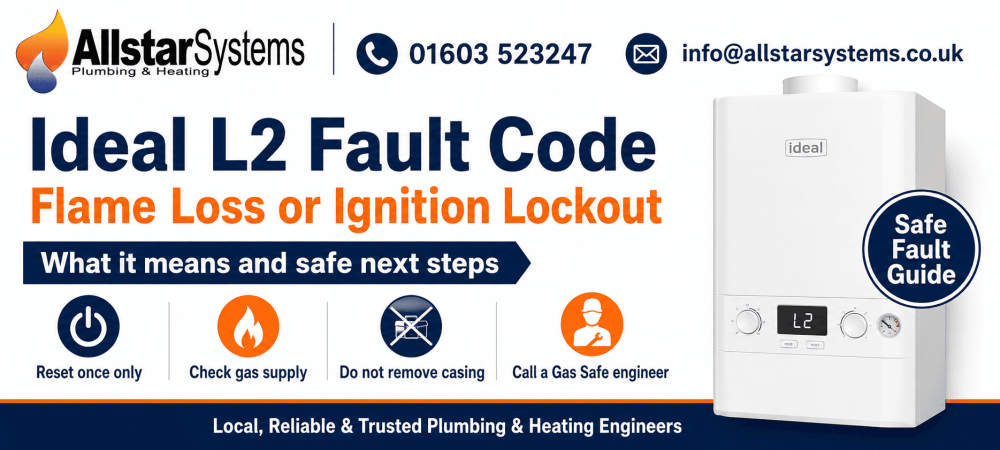
An Ideal L2 fault code usually means the boiler has lost its flame or failed to complete start-up. In simple terms, the burner has not lit correctly, or it has lit and then gone out.
When this happens, the appliance locks out for safety. As a result, your heating, hot water, or both may stop.
L2 can have several causes. These include an interrupted fuel supply, a frozen condensate pipe, worn ignition parts, flame sensing issues, a dirty burner, poor combustion, flue concerns, wiring faults, or control board problems.
What Does Ideal L2 Mean?
Ideal L2 normally points to flame loss or ignition lockout.
A boiler needs a steady flame before it can heat water. If the burner fails to light, the appliance cannot run. Likewise, if the flame drops out after start-up, the appliance must shut down.
This lockout helps prevent repeated unsafe firing attempts. However, if the warning returns, the cause needs proper testing.
Flame Loss Explained
Flame loss means the boiler started to fire, but the flame did not stay stable.
This can happen when the fuel supply is poor, the burner is dirty, or the flame sensor cannot confirm combustion. It can also happen if the condensate pipe is blocked or frozen.
Because several parts can create the same warning, diagnosis matters.
Ignition Lockout Explained
Ignition lockout means the boiler tried to start but could not complete the lighting sequence.
You may hear clicking, sparking, or a short firing attempt. Then the appliance stops and shows the warning.
This does not mean you need a replacement boiler. However, it does mean the appliance has found a fault that needs attention if it happens again.
Common Signs of an Ideal L2 Fault
You may see L2 on the display. Your radiators may stay cold, and taps may stop producing hot water.
The appliance may click, spark, start briefly, then shut down. You may also hear gurgling near the condensate pipe, especially in cold weather.
If other fuel-burning appliances have stopped working too, the issue may affect the property supply rather than the boiler alone.
Common Causes of Ideal L2
Several issues can trigger this warning. Most relate to fuel supply, ignition, combustion, drainage, or controls.
No fuel supply to the appliance
If fuel is not reaching the boiler, the burner cannot light. Check whether other fuel-burning appliances work.
If you use a prepayment meter, make sure it has credit. Also, check whether the meter has tripped.
Isolation valve turned off
A nearby isolation valve may have been turned off during recent work. However, do not adjust any valve inside the boiler.
If you feel unsure, call a qualified engineer.
Frozen or blocked condensate pipe
A blocked condensate pipe can stop the boiler working correctly. This is more common during freezing weather.
Gurgling noises can be a useful clue. If you suspect a frozen pipe and feel unsure, arrange professional help.
Faulty ignition electrode
The ignition electrode creates the spark that lights the burner. If it is worn, cracked, dirty, or misaligned, ignition may fail.
This part sits inside the boiler and needs Gas Safe inspection.
Flame sensing issue
The boiler must confirm that a flame is present. If the sensor, wiring, earth path, or combustion setup is poor, the appliance may shut down.
These checks need proper testing.
Gas valve problem
The valve controls fuel flow to the burner. If it sticks, fails, or receives the wrong signal, the boiler may not light.
Valve work must never be a DIY task.
Low inlet pressure
Low inlet pressure can stop the burner holding a stable flame. The cause may involve the meter, pipework, supply, or internal parts.
A Gas Safe engineer can test this safely.
Dirty burner or poor combustion
A dirty burner can cause weak or unstable combustion. Over time, this may lead to repeated lockouts and lower efficiency.
Annual servicing helps reduce this risk.
Flue or air supply concern
The boiler needs safe air movement and a clear flue route. If the flue path is unsafe, the appliance may stop.
Do not inspect or alter flue parts yourself.
PCB or wiring fault
The control board manages ignition, sensors, valves, and safety checks. If wiring or the PCB develops a fault, the burner may not light correctly.
However, an engineer should test simpler causes before blaming the PCB.
Safe Checks Before Calling an Engineer
You can make a few basic checks without opening the boiler.
First, check whether other fuel-burning appliances work. If none work, the issue may relate to your supply.
Next, check your meter. If you use a pay-as-you-go meter, make sure it has credit.
Then, confirm the boiler has power. Check the fused spur, timer, thermostat, and room controls.
After that, look for signs of a blocked or frozen condensate pipe. This is especially useful during cold weather.
Finally, try one reset if your Ideal manual allows it. If L2 clears and stays away, monitor the appliance.
However, if the warning returns, stop resetting it. Repeated resets will not repair an ignition, flame sensing, supply, flue, or control issue.
Important safety note: never remove the boiler casing. Do not touch gas parts, burners, electrodes, wiring, fans, flue sections, or sealed components yourself.
What to Avoid
Do not keep pressing reset. This can delay diagnosis and place extra strain on parts.
Do not follow unsafe online repair advice. Also, do not assume one cause without testing.
If you smell gas, turn off the emergency control valve if safe. Then open doors and windows, avoid electrical switches, leave the property, and call the National Gas Emergency Service on 0800 111 999.
When to Call a Gas Safe Engineer
Call an engineer if L2 returns after one reset. You should also book help if the appliance keeps clicking, starts then stops, or makes unusual noises.
Also, arrange support if heating and hot water keep failing. Repeated ignition lockouts need proper investigation.
An engineer can test inlet pressure, condensate drainage, ignition parts, flame sensing, burner condition, valve operation, fan performance, flue safety, wiring, and PCB response.
Can L2 Damage the Boiler?
L2 is designed to protect the boiler by stopping operation. However, the underlying problem can still cause wear if ignored.
Repeated failed starts can strain ignition parts. In addition, combustion or supply issues need prompt attention.
Early diagnosis helps protect the appliance and restore reliable heating.
How to Reduce Future L2 Problems
Annual servicing helps lower the risk of ignition faults. During a service, an engineer can inspect the burner, electrodes, combustion performance, seals, and safety controls.
Also, protect external condensate pipework during cold weather. If freezing has caused past lockouts, ask an engineer about insulation or pipe improvements.
In addition, act early if you notice slow ignition, repeated resets, odd noises, or unreliable heating.
Why Choose Allstar Systems?
Allstar Systems provides boiler repairs, fault finding, and heating support across Norwich and Norfolk.
Our engineers work with gas, oil, LPG, and electric heating systems. We give clear advice before carrying out repairs and always aim to find the real cause.
If your Ideal boiler keeps showing L2, we can inspect the supply, condensate route, ignition parts, flame detection, burner, flue, and controls.
Final Advice on Ideal L2
Ideal L2 usually means flame loss or ignition lockout.
Start with safe checks. Check your meter, other fuel-burning appliances, boiler power, external controls, and condensate pipe. Then try one reset if your manual allows it.
If the warning returns, call a Gas Safe engineer. The cause may involve supply, condensate drainage, ignition parts, flame sensing, combustion, flue safety, wiring, or the control board.
FAQS About Ideal L2 Fault Code:
What does L2 mean on an Ideal boiler?
L2 on an Ideal boiler means flame loss or ignition lockout. The boiler has failed to ignite or has lost the flame during operation.
Can I reset an Ideal boiler with an L2 fault?
Yes, you can try one reset after basic checks. However, if the L2 fault returns, contact a Gas Safe registered engineer.
Can a blocked condensate pipe cause an Ideal L2 fault?
Yes, a blocked or frozen condensate pipe can contribute to ignition lockout on some Ideal boilers. This often happens during cold weather.
Why does my Ideal boiler keep showing L2?
A repeated Ideal L2 fault can suggest gas supply problems, a blocked condensate pipe, faulty ignition electrode, flame sensing issue, gas valve fault, burner issue, flue issue, wiring fault, or PCB problem.
Is an Ideal L2 boiler fault dangerous?
The lockout helps protect the boiler. However, ignition and flame faults involve gas combustion, so repeated L2 faults need professional attention.
Can I fix an Ideal L2 fault myself?
You can check your gas meter, test other gas appliances, look for a blocked condensate pipe, and reset the boiler once. However, internal repairs need a Gas Safe registered engineer.
Why does my boiler click but not ignite?
Clicking can mean the boiler is trying to ignite. If it fails, the issue may involve gas supply, ignition electrodes, flame detection, gas valve operation, or control components.
How much does it cost to fix an Ideal L2 fault?
The cost depends on the cause. A simple condensate pipe issue may cost less, while gas valve, electrode, fan, PCB, or combustion repairs may cost more.
How can I prevent ignition lockout faults?
Book annual boiler servicing, protect the condensate pipe in cold weather, act on unusual noises early, and avoid repeated resets when a fault returns.